
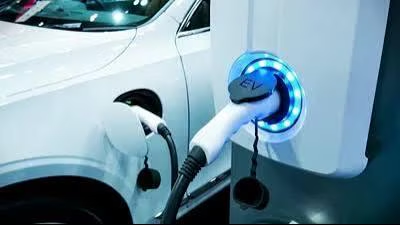
Notwithstanding the green mobility push, Panchkula has only 51 public electric vehicles (EV) chargers, the fourth-lowest among Haryana’s 23 districts, according to official data up to June 2026.
Only Charkhi Dadri, Kaithal and Fatehabad have fewer public chargers – 19, 42 and 43, respectively. In contrast, Gurugram accounts for nearly 49% of Haryana’s public EV charging infrastructure, followed by Faridabad and Rewari. The state, according to official data, has 3,653 public EV chargers.
The government is also seeking to bridge gaps in charging infrastructure, which officials have identified as a factor behind the relatively slow adoption of EVs. Registrations rise after fresh policy The pace of EV registrations picked up after Haryana introduced a new policy in July, granting a 100% exemption from motor vehicle tax on battery-operated EVs priced up to ₹ 30 lakh (ex-showroom). Vehicles priced above ₹ 30 lakh are eligible for a 50% exemption. Panchkula recorded 10 pure EV registrations in January, while the number rose to 31 in September, according to official data. Administrative delays had affected the process, while the 2022 policy provided a 20% rebate on motor vehicle tax. Under the central scheme, ₹ 2,000 crore has been earmarked on a first-come, first-served basis for identifying government land parcels and setting up additional charging stations. Officials have, however, flagged that ₹ 730 crore has already been utilised by early-mover states, raising concerns that delays could put the remaining non-recurring central assistance at risk.
The new policy replaced the earlier system under which buyers paid the full motor vehicle tax upfront and subsequently claimed cash subsidies online.
