
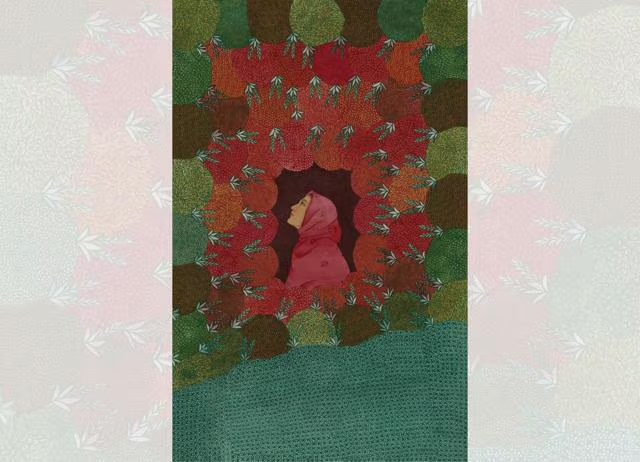
Hakeem’s brother was murdered in a targeted killing in 2018. To understand Feroza Hakeem’s paintings, it’s essential to know her story. She was born into the marginalised Hazara community in Quetta, a semi-arid region in Balochistan in Pakistan, where her grandfather had migrated decades ago to escape the violent persecution of their Shia community by the Sunni rulers of their native Afghanistan. But even with the change in location, the marginalisation and hatred against Shias continued.
As an artist, Hakeem turns this fraught personal and communal history into bright and beautiful naturescapes created in the Persian miniature style. There are no straightforward scenes of violence or suffering. Instead, the grief, tension and centuries of subjugation are sensitively layered within vibrant mountains, flowers, trees and streams. Nature becomes the receptacle to store memories and heal from long-held scars.The landscapes are beautiful, but not innocent. They draw from the struggle and resilience of the Hazara community spread across southern Afghanistan and western Pakistan. They’re laden with loss, and a strange sense of hope. I am drawn to this tension; to the possibility that something beautiful can hold something painful without the need to illustrate the pain in an obvious manner. Her Persian miniature style looks traditional and meticulous, but they’re definitely of the present. In some works, the decorative borders of Mughal miniatures are replaced by newspaper cuttings and photographs recording the violence against her community members. In others, she repeats motifs to create layers without filling up every inch of space with a natural element.
Born in 1995, Hakeem graduated from the National College of Arts in Lahore in 2019, having spent a semester at the Siena Art Institute, Italy.
