
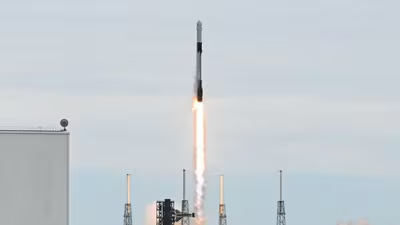
A SpaceX rocket lifted off from Florida on Thursday with a crew of two US astronauts, a Canadian astronaut and a Russian cosmonaut headed to the International Space Station for a science mission devoted to human health and performance in orbit.
The rocket’s upper stage climbed higher and released into orbit the Crew Dragon carrying NASA astronauts Jessica Watkins and Luke Delaney, Canadian astronaut Joshua Kutryk and Russian cosmonaut Sergey Teteryatnikov. The company went public in a record-breaking IPO in July. The two-stage Falcon 9 rocket, topped with an autonomously operated Crew Dragon capsule carrying the four-member crew, was launched from the Cape Canaveral Space Force Station, along Florida’s Atlantic Coast. Falcon 9’s reusable lower-stage booster separated from the rest of the vehicle within three minutes of launch and flew itself back to Earth for a return landing. The capsule is thrusting itself along an eight-hour orbital voyage to the space station and is set to dock with the orbiting laboratory platform some 250 miles (400 km) above Earth around 7 p.m. EDT (2300 GMT). The mission marks the 13th long-duration space station team that NASA has flown aboard a SpaceX launch vehicle since the rocket venture founded in 2002 by Elon Musk began sending US astronauts to orbit in May 2020.
The launch also comes days after SpaceX launched its next-generation Starship spacecraft on its first trip to orbit and first commercial satellite deployment, marking the vehicle’s 14th uncrewed test flight since 2023. Crew 13 is led by geologist-turned-astronaut Watkins, 38, making her second voyage to space and becoming the first NASA astronaut to fly twice aboard a Crew Dragon. Seated beside her in the pilot’s chair is Delaney, 47, a former test pilot and fighter pilot making his debut in space.
The latest arrivals are expected to focus their attention on a series of biomedical and human performance studies, including research on how microgravity affects blood circulation and clotting, and gathering health data to inform future space missions.
