
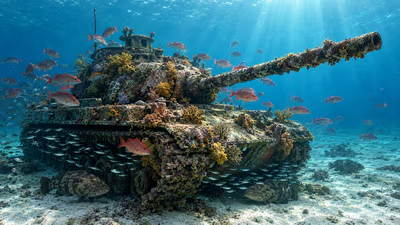
Yet in 1994, 100 of them took a one-way trip to the bottom of the ocean off Alabama, and fish were supposed to move in. In 1993, the military needed a way to retire obsolete battle tanks. The tanks went down in three rounds in 1994, with six on June 1, 58 in late July, and the last 36 on September 26, according to the Alabama Department of Conservation and Natural Resources .
Battle tanks were built to roll across land, not to rest on the sea floor.
The question with artificial reefs is, are they increasing the number of fish or just attracting fish from the neighborhood? But there is a caveat. Those structures occupy only a small slice of the northern Gulf. Artificial structures, particularly oil platforms, tend to attract mostly juvenile fish. The study examined artificial structures in general, such as oil platforms and artificial reefs , so it is not a finding specific to tanks. It also projected that the tanks could have an economic impact in the millions of dollars over that time.
Useful numbers on where red snapper live come from a 2017 study published in Marine and Coastal Fisheries . NOAA and University of South Alabama researchers used data from a 2011 red snapper survey throughout the northern Gulf of Mexico. The study found that catch rates for the youngest red snapper were approximately 20 times greater on artificial structures than on natural reefs. They are estimated to account for less than 14 percent of the abundance of red snapper. So their share of total red snapper biomass was even lower, at 7.8%. The state’s conservative estimate put the tanks’ lifespan at 50 years as reefs. Counting from 1994, that would run through 2044. However, it’s worth noting that the 50-year number is a projection, not a guarantee.
