
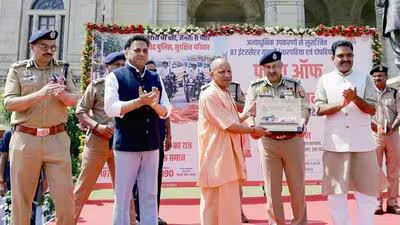
Chief minister Yogi Adityanath on Thursday sharpened his government’s law-and-order pitch ahead of the 2027 Uttar Pradesh assembly polls, highlighting police reforms, technology and enforcement infrastructure as key elements of its governance record and contrasted it with the situation before 2017, alleging that dreaded mafiosi held sway across the state and parallel systems of power operated in several areas back then.
The chief minister described road safety as a major challenge. The chief minister also conferred President’s Police Medals for Gallantry on 16 personnel whose awards had been announced for Republic Day 2025 and Chief Minister’s Police Medals for Gallantry on 10 personnel whose awards had been announced for Republic Day 2026. Citing figures, he said that 23,000-24,000 people died in road accidents every year in Uttar Pradesh.
He said road-safety violations affected not only individuals involved in crashes but also their families and society, stressing the need for technology-backed enforcement to reduce fatalities.
He also referred to poor residential facilities for police personnel, the disbanding of PAC battalions and prolonged curfews following communal violence in Kosi Kalan, Meerut, Aligarh and Muzaffarnagar. He said more than 14 lakh cameras had been installed in cities under the Safe City initiative, while Integrated Command and Control Centres had been established in districts. The chief minister said before 2017, the police faced inadequate infrastructure and limited training capacity, with around 6,000 personnel being trained annually. He said his government had worked since 2017 to change these conditions while advancing the state in areas, including the economy, employment, technology and implementation of welfare schemes.
Addressing a programme at Lok Bhavan, he said Uttar Pradesh had become the first state to implement the police reforms advocated by former director general of police Prakash Singh. He said seven police commissionerates were now functioning in the state and described the policing approach as a combination of ideas, courage and technology. The surveillance network, he said, was helping police prevent crimes and detect incidents after they occurred. Recalling the security situation in the Terai region, the chief minister said movement there had once required police and military protection and largely stopped after sunset. He said Prakash Singh had faced such challenges during his tenure as DGP.
