
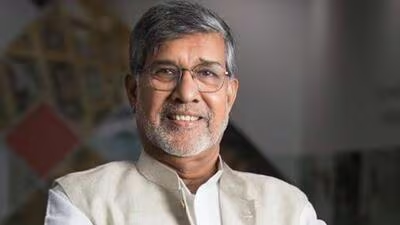
Nobel laureate Kailash Satyarthi has laid out his vision for the future development of Artificial Intelligence (AI) amid a deepening race between companies and nations to dominate the technology. In an exclusive conversation with HT, Satyarthi spoke about a new framework for the future of the technology, which he calls Compassionate AI. Edited excerpts:
So I was invited there as a keynote speaker in the inaugural ceremony, and then I asked this question: you say AI for good, but good for whom? Are these people the invisible people who may not be using your product, who may not be your customer? The second thing is that the algorithms are biased, and we have seen the results of it. My solution was that compassion should be the principle in designing, development, and deployment, and that should flow everywhere. I’ve met dozens, maybe hundreds of engineers and scientists and developers and deployers and some of the companies’ investors in the last three days. My proposal to them was that how many of your engineers, code writers and developers have ever met those people whom you are talking to about? You are talking about bringing good in the lives of billions of people in the world. Have you ever seen them? Have you ever met with them? So my proposal is to invite these engineers to go and live for some time in Africa, in South Asia, in Latin America, in the villages, in rural communities, and sit with them and try to understand what their problems are. It’s been tremendous, and it began from the AI summit in Geneva in July, when I brought this idea of compassionate AI. Dozens of companies and the heads of state of two countries – one prime minister and one president – approached me just there in the hall, in the room, when I finished my talk, and called it a great idea. It is not preaching. It is not just talking of humanity and morality. I am trying to bring the engineering solution of this deep engineering problem. Have you also spoken to those companies that are really at the forefront of developing this technology such as Anthropic, OpenAI and Google? How was your idea perceived by them? For me, the biggest threat to humanity is who is going to control whom? Will humans control machines or will machines control human decisions? These technologies are in the control of eight or nine companies whose profits and whose wealth is more than the GDP of countries. So they are very powerful companies. So, how to democratize data? How to democratize technology? These are big questions. Humanity itself is under risk, and that risk has to be addressed now, not with fear, not with negative reactions, not with being frightened about it, but by using the human conscience to solve these problems with wisdom and intelligence.
We talk about how India is trying to become a $5 trillion economy, but some of these companies have already achieved more than that. Because it’s very practical, similarly, some local groups and universities organized events with developers, engineers, investors, and so on, and that is being resonated so well. Because humanity itself is under stake, but the threats are bigger.
Recently, there was a United Nations Summit on AI on technology in Geneva entitled “AI for Good”. Biased means the mindset, the biases of engineers is put into it, as I said, and that is resulting in larger harms. Yesterday, I was in Stanford and before that I was also talking to engineers at the SAP Institute.
