
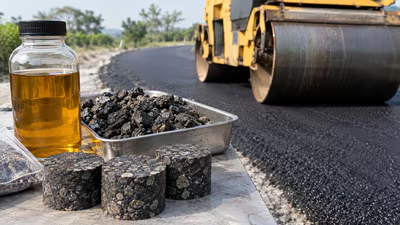
In all kitchens, there is usually some used cooking oil that is difficult to dispose of. Some of it ends up in the trash, while civil engineers have explored whether it could instead become a component of road pavement. Laboratory research has shown that waste cooking oil can soften the aged binder in old asphalt, potentially making it easier to incorporate large amounts of reclaimed pavement into new mixtures.
Majidifard and Buttlar were affiliated with the University of Missouri, while Tabatabaee was affiliated with Sharif University of Technology in Iran, where the Asphalt Pavement Lab equipment was used for the testing. Recycled asphalt, or RAP, is reclaimed asphalt pavement that has been milled and prepared for recycling. Using RAP reduces the need for new aggregates and asphalt binders while giving old pavement another use instead of sending it to waste after resurfacing.
In the 2019 study in the Journal of Traffic and Transportation Engineering, Hamed Majidifard, Nader Tabatabaee, and William Buttlar studied waste cooking oil as a recycling agent in asphalt made primarily from recycled pavement. The laboratory experiments demonstrated the possibility of designing asphalt mixes with 60% to 100% recycled content using waste cooking oil.
The University of Missouri researchers said that rising costs of raw materials and energy made finding ways to increase the proportion of recycled materials in asphalt especially relevant.
However, the softened binder had certain drawbacks. As more oil was added, the mixtures showed lower resistance to rutting and weaker moisture resistance. More recent research examined the same question using different recycled asphalt mixtures. Chandrappa tested waste cooking oil in mixtures containing different amounts of recycled material and evaluated properties including rutting, fatigue, and durability. Their laboratory results showed that recycled mixtures containing an ideal amount of waste cooking oil had rutting and cracking resistance comparable to conventional hot-mix asphalt in the tests conducted. Jain and Chandrappa attributed the increased affinity for moisture in the mixtures to the acidic nature of the waste cooking oil and asphalt considered in their study, and they evaluated ways to reduce the resulting moisture damage. Their results showed that the amount and method of adding the oil mattered, with dry addition providing greater moisture resistance than the wet method in their tests and antistripping agents offering a further improvement. Both studies were laboratory investigations, so their results did not establish how these mixtures would perform over years of traffic, weather, and seasonal temperature changes on an actual road.
The researchers also noted that China produced roughly 5 million tons of waste cooking oil each year, citing earlier research. They noted that its flash point was above 220 degrees Celsius, a property relevant to its use in hot-mix asphalt. In their tests, adding 10% to 16% oil improved the low-temperature properties of the aged binder, shifting its low-temperature grade from about minus 10 degrees Celsius to between minus 22 and minus 28 degrees Celsius. The mixture containing 16% oil lost about 43% of its wet tensile strength compared with the corresponding mixture without oil, although its moisture susceptibility ratio remained within the study’s acceptable range. In a 2025 paper in the Journal of Materials in Civil Engineering, Shobhit Jain and Anush K. The 2025 study also found that moisture susceptibility remained an important consideration. The 2019 researchers called for additional work to determine suitable oil doses and assess long-term performance, with the appropriate amount depending on factors such as the climate and condition of the pavement.
More field testing would therefore be needed before the laboratory findings could be translated into expectations for full-scale pavement projects.
