
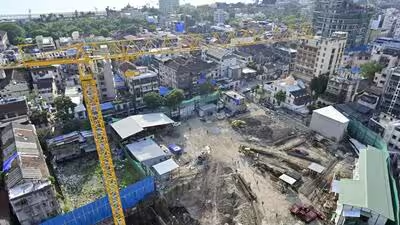
Mumbai: A nineteenth-century wadi in south Mumbai is set to make way for a 325-metre luxury residential tower, with Godrej Properties joining Man Infraconstruction Ltd (MICL) and Shreepati Group coming together to revive a redevelopment project that has been stalled for over 15 years.
The project could not take off for years due to several factors, including insufficient funds. Zaoba Wadi in Thakurdwar, spread across about 2.5 acres, is home to around 625 tenants who live in traditional chawls and low-rise residential buildings, some of whose units are also used for commercial purposes. Under the redevelopment plan, the tenants are to get flats of about 550 sq ft each, compared with their existing 150-200 sq ft units. The redevelopment of Zaoba Wadi, which had stalled since the Shreepati Group acquired rights in 2011, is now being taken forward by the three developers. Discussions began in early 2024 for MICL to join as development manager, handling construction management and marketing under an asset-light model. The company formally partnered on the project in 2025. The plan was initially for an ultra-luxury residential tower of more than 800 feet (244 metres), but permission was subsequently secured for a taller structure. “Over and above, MICL Group will recoup its existing investment in the project to the tune of ₹ 300 crore. Godrej Properties said the project has an estimated overall revenue potential of around ₹ 6,000 crore.
People familiar with the development said the Shreepati Group, MICL and Godrej Properties formally came together last week to push the project forward. Describing it as one of the most prestigious projects in its portfolio, MICL managing director Manan Shah said, “The transaction with Godrej unlocks the project’s full potential and marks an important milestone in MICL’s journey. Our tailor-made developments for south Mumbai have been particularly well received, which gives us confidence in the long-term attractiveness of well-located, high-quality homes in this market,” said Gaurav Pandey, managing director and CEO, Godrej Properties. “Marine Lines is one of the city’s most prestigious addresses, and we are delighted to add this landmark opportunity to our portfolio.”
Discussions with Godrej Properties over its entry into the project had been underway for several months before being finalised last week. The early realisation of cash flows from the project will provide MICL with greater financial flexibility to pursue new development opportunities and expand its presence in Mumbai. Shah added that MICL would continue to benefit from the project through a revenue-sharing arrangement. The project will also be jointly branded as part of the collaboration. The development rights held jointly by Shreepati Group and MICL have now been transferred to Godrej Properties. “Mumbai continues to be a key market for us, and our premium and luxury projects in the city have seen a consistently strong response.
Since then, initial permissions have been secured, and the developers have been acquiring the remaining development rights from existing occupants. MICL announced its collaboration with Godrej Properties on Monday.
Shah said the new tower would be 325 metres high, with about 600,000 sq ft of saleable carpet area and around 1.3 million sq ft of rehabilitation carpet area. The entrance to the wadi is marked by the Zaoba Ram Mandir, a heritage-listed structure that was reportedly built in 1882.
It has a white marble statue of the deity, giving it the name “Gora Ram” or fair Ram. The project will comprise four- and five-bedroom luxury residences. The rehabilitation component is expected to be completed in four years and the saleable component in five years. Zaoba Wadi is part of the old Girgaon-Thakurdwar neighbourhood, where traditional residential communities, chawls and small commercial establishments developed alongside one another. The temple was originally an Anglo-Indian wada (bungalow) belonging to a Pathare Prabhu family (one of the oldest original settler groups of Mumbai). Over the decades, as Mumbai’s demographic landscape evolved, many Pathare Prabhu families migrated elsewhere, including farther north into spacious homes in the suburbs or smaller homes. The redevelopment of Zaoba Wadi is part of a wider transformation of the old wadi neighbourhoods of south Mumbai.
Amar Wadi and Pimpal Wadi near CP Tank were among the earlier wadis to undergo redevelopment, while parts of Mangal Wadi, Khotachi Wadi, Chandan Wadi, Talmaki Wadi and Chikal Wadi in Tardeo have also faced redevelopment pressures. The grand family estates and bungalows of Zaoba Wadi gradually made way for the iconic chawls and mixed-use commercial printing and textile-trading workshops that define the Kalbadevi-Thakurdwar neighbourhood today.
