
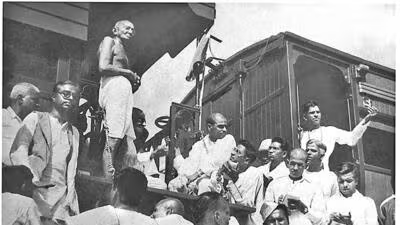
MUMBAI: The Indian Railways is seen as the leitmotif of Mahatma Gandhi’s over three decade-long struggle to free India from the British Raj which, ironically, introduced the locomotive to the sub-continent in the 19th century. Soon, the Mahatma’s message began to run furiously on the Great Indian Peninsula Railway, and Bombay, Baroda and Central India railway tracks – the two branches of the Indian Railways, cutting a swathe across communities, cultures and geographies.
“Gandhi would often say that he can safely claim without a tinge of arrogance that he is India’s most widely travelled public figure,” said activist and Gujarati writer Ramesh Oza.
A cop threw him out of a first class coach, rudely dismissing the young barrister’s claim that he had a valid ticket. Stranded on the station in the middle of a severely cold night, Gandhi, lonely and desolate, quietly contemplated on his future. “The Pietermaritzburg night was a defining moment for Gandhi and for India as well. As the train roared through villages, dusty plains, forests and towns Gandhi would read and write countless letters and the ‘Young India’ editorials, eat his meal of dates and grapes, and pray, and laugh and joke with his colleagues.”
Oza said the Pietermaritzburg episode in South Africa, in 1893, green signalled Gandhi’s love affair with the Railways.
He turned into a rebel, set aside the thought of returning to India and resolved to fight British imperialism and racism,” said Oza. Describing Gandhi as a “tireless traveller”, Kulkarni said, “The railway compartment was a second home for him and his followers.
At every station Gandhi would perch himself on the footboard and greet the crowd with a ‘namaste’, often chiding a diehard fan who tried to get into the compartment through the window. Realising that Gandhi’s arrival throws its time table out of gear, the railway authorities, in later years, designed a special salon for Gandhi and his team, although he didn’t much avail of the amenity. I wasn’t sure if ‘Railway Aani Gandhi’ would make any sense in the times of AI. I agreed when Kulkarni pointed out that the Gandhi-railway story talks of resilience — both Gandhi’s and that of the Indian Railways. Both complemented each other.”
Pointing out that Gandhi, a virulent critic of modern technology cleverly used the colonial contraption to unify India, Oza said, “The realist in Gandhi understood the socio-political significance of the railways and its incredible reach – that he pressed into service the railways and the printing press to challenge the British Raj was a master stroke. Stating that he was initially apprehensive about Kulkarni’s book, publisher Swanand Bedarkar said, “I had the manuscript for three nearly three years.
