
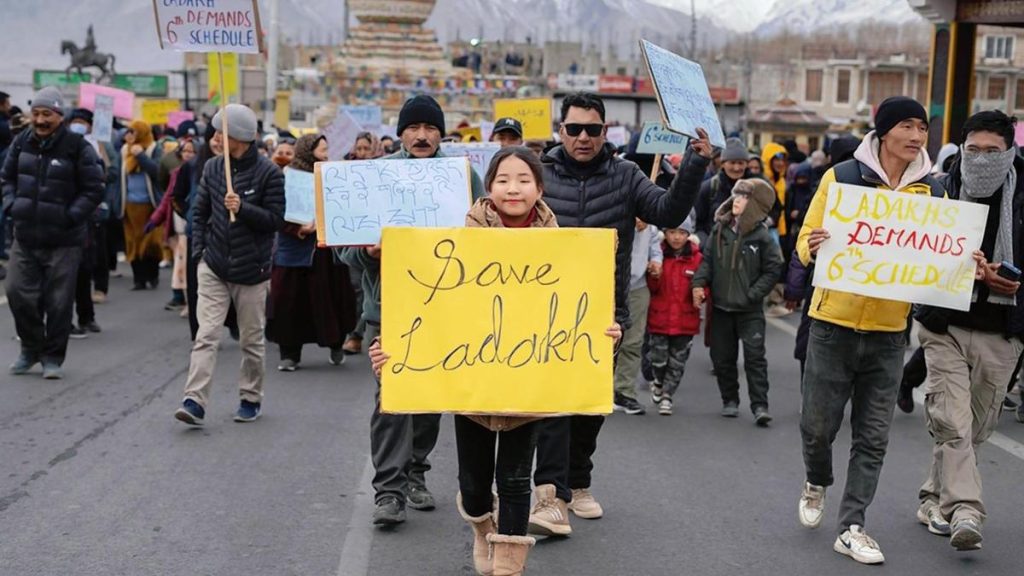
Union of India (1977). The demand by Ladakh for Sixth Schedule status and the proposal made by the Ministry of Home Affairs to provide for a directly elected legislative body for governance in the Union Territory has created a paradoxical situation and raised the question of whether a UT can be granted such status. Whether it would be constitutionally valid to equate States and UTs in the context of their respective governance is a question worth examining. Indian federalism is unique in the sense that, in general, it functions as a federation, while during an Emergency, it becomes perfectly a union. This observation signifies that while India intends to distribute the resources equitably through its federal structure, it retains a unitary character to ensure the unity and integrity of the nation.
This is why the Supreme Court has called it “Amphibian” in State of Rajasthan v.
Moreover, India’s territory includes States, UTs and any other territory acquired under international law, making it a decentralised federal design. The political idea behind this design is to include every cultural and ethnic group in democratic governance to sustain its political structure. This has also been the primary reason for the provisions of the Fifth and Sixth Schedules, which provide for Scheduled Areas and Autonomous Districts, especially to ensure the inclusion of tribal communities. Considering its unique ethnic composition and cultural specificity, Ladakh has demanded Sixth Schedule status. However, the Central Government is unwilling to provide this status and has instead proposed an elected legislative authority for a sui generics model of governance. Meghalaya, Tripura, and Mizoram later became separate States, retaining their Sixth Schedule protections. The Governor has the power to create new Autonomous Districts through a public notification. In short, the States covered by the Sixth Schedule enjoy considerable autonomy in governance. If the Government grants special status under the Sixth Schedule to Ladakh, the autonomy it would receive might prove detrimental to national security, given Ladakh’s strategic location in the vicinity of China. However, the ethno-cultural aspects of Ladakh must also be protected through an efficient and autonomous local government. Against this backdrop, the proposal to provide a directly elected legislative authority appears more rational, as it would not only ensure adequate and proper political representation but also involve the local population in the decision-making process. The proposed structure may place this body above the existing Ladakh Autonomous Hill Development Councils (LAHDCs), while retaining panchayats and district-level institutions. However, the role of the Lieutenant Governor after the constitution of this authority is yet to be clearly defined. As India is a functional federation in which financial and residuary powers are vested in the Union rather than the States, it remains to be decided whether the legislative authority would enjoy any such powers. Granting special status or providing a sui generis model of governance to a Union Territory is certainly constitutionally valid, as India’s constitutional governance practices equitable distribution of rights among States and other units within its territory. This makes it clear that Parliament may grant special status to any UT.
The Sixth Schedule is governed by Article 244(2) and 275(1). Each such district is governed by a district council with a maximum of 30 members. The Government has proposed to insert Article 371-K in Part XXI of the Constitution (Temporary, Transitional and Special Provisions) to strike a balance between national administration and local self-government. Earlier, through constitutional amendments, Parliament has made special provisions for the National Capital Territory of Delhi under Articles 239 AA and 239 AB.
From a functional perspective, this design is founded on the ‘Doctrine of Proportionality’, so that the Rawlsian principle of justice, i.e., the greatest advantage to the least advantaged could be achieved. It also practises the principle of proportionality and may, therefore, provide special powers or status to a UT based on its location, developmental requirements and the need to protect its democratic identity.
The Sixth Schedule covers only Assam, Meghalaya, Tripura and Mizoram primarily because most of these areas were part of Assam during British rule and were classified as “Excluded” or “Partially Excluded” areas. Further, the extent of powers that the said authority might enjoy, particularly in terms of financial autonomy, remains to be seen.
