
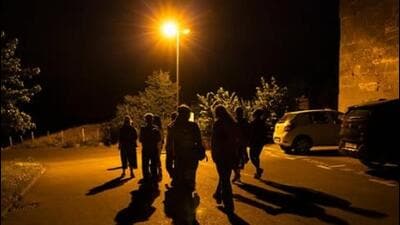
A 23-year-old advocate from Delhi, a 29-year-old psychotherapist from Noida, and a 24-year-old freelance writer from Meerut were among nearly 60 women who gathered on Saturday night for a solidarity walk organised by Women Walk at Midnight, an initiative launched in 2016 and inspired by the 2012 Nirbhaya movement.
Earlier this week, a 17-year-old school student was allegedly gang-raped by three men inside Aastha Kunj Park in Kalkaji area , resurfacing women safety issue in Delhi. The mother-daughter duo—Himanshi T (29) and Nidhi T (53), who travelled from Noida for the walk—said that at 11.30 at night, a time usually carved out for men to occupy public spaces, they nonetheless felt a strong sense of belonging. I found myself wanting to keep walking—to just keep moving forward, without turning back to look behind me,” the 53-year-old added. Standing next to her in a black raincoat her daughter, Himanshi (29) said her mother was initially very hesitant to talk to strangers. Additionally, in nearly a decade of organising such walks across Delhi, Saturday’s walk marked the first time that around 20 police personnel and four PCR vans were deployed for security, and moved alongside these women in the lanes of Kalkaji. Reflecting on the first walk under the banner Women Walk at Midnight on December 4, 2016, Mallika Taneja, said she wanted to take a 24-hour lone walk, but that duration also meant walking through the night. “Has something big changed between Nirbhaya and the recent gang rape of a 17-year-old, and also Unnao, Kathua and RG rape?
Twenty-one-year-old Tamana Chauhan, who joined the walk for the first time, said her mother would never have allowed her to come, especially to a locality where a gang rape was recently reported. Braving the rain, the women walked through dimly lit lanes of Kalkaji with umbrellas in hand, expressing solidarity with survivors of violence in Kalkaji, Jamui and Samastipur . “But at the same time the thought that what if something happens troubled me so I informed my friends. I kept on thinking what if someone pulls me aside out of nowhere in the streets throughout the walk which is why I preferred walking in between,” Chauhan, a Delhi University undergraduate student added. “The first time I came for a walk was two months ago. I had simply come to accompany my daughter for a walk in Shaheen Bagh. “But walking alongside other women felt different. There was a sense of being held, of having a chain of protection all around you. “During our first walk, she simply stayed by my side. This time, however, within a few minutes of starting the walk, we were metres apart, each having found our own group of people to mingle with. Over the course of the two-and-a-half-hour walk, the women navigated some streets with moving vehicles and eateries preparing to close for the night, and many other— dimly lit lanes where an eerie silence prevailed, broken only by occasional bursts of chatter and laughter. Not really. But every woman who chooses to be part of these walks feels something about herself.
“It’s best to tell her after the walk,” she said. During my college days, there was nothing quite like this, and even if there had been, the perception was that such spaces were meant for ‘activist-type’ women,” said Nidhi T. So there are so changes at individual and community level,” said Taneja. “But that bigger change—towards a time when we can simply walk at night, without doing so in solidarity with a victim or survivor—will take time to happen,” she added.
The sense of unfamiliarity among those who met at the outset of the walk gradually gave way to familiarity. Over the course of the walk, they exchanged numbers, made plans to attend future walks, and parted with warm goodbye hugs.
