
However, political party booths continued to record high noise levels, including after midnight, in violation of the 10pm to 6am restriction on loud music, according to a report by environmentalist Sumaira Abdulali of Awaaz Foundation, submitted to chief minister Devendra Fadnavis on Saturday. MUMBAI: Most Ganpati visarjan processions in Mumbai on September 25 and 26 appeared to have turned down the volume on loudspeakers and DJ music compared with last year.
Her report found that several processions were conducted without loudspeakers or generators, while the highest readings were recorded at locations where loudspeakers, banjos or dhol-tasha were being used. The noise continued past midnight. Abdulali also raised questions over the placement of police decibel meters. Abdulali has submitted the findings to the chief minister, Mumbai police commissioner and chief secretary, seeking attention to the continued enforcement of noise rules during religious festivities. HT reached out to the chief minister and his office for comment, but did not receive a response till the time of going to press.
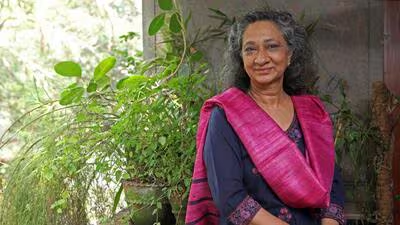
Abdulali, who has documented noise levels during Ganeshotsav since 2003, travelled across Mumbai from Bandra to Girgaon Chowpatty on September 25 and 26 to record sound levels from the streets. At 10.03pm in Bandra West, a banjo with loudspeakers recorded 91 to 107.8 decibels. A dhol-tasha procession in Worli at 10.28pm recorded 94 to 107 dB despite not using loudspeakers. At 11.15pm, a political party booth at Girgaon Chowpatty recorded 92 to 103 dB while playing music through loudspeakers. At 12.18am on September 26, a political booth at Girgaon Chowpatty recorded 87 to 94 dB, while another reading at the same location at 12.30am showed 82 to 90 dB, with loudspeakers still being used. At the Opera House, a procession without loudspeakers recorded 84.9 to 87 dB at 12.06am. Abdulali said in her letter that although the state can notify up to 15 days a year when loudspeakers may be permitted until midnight, this does not mean the applicable ambient noise standards are relaxed. Under the Noise Pollution Rules, the night period is from 10pm to 6am, with the prescribed ambient standard at 45 dB for residential areas and 40 dB in silence zones.
She said she was informed along the route she covered that the meters had been installed on towers rather than being carried by personnel moving with the processions. She told HT that the readings would also be influenced by the distance from the points where loudspeakers were actually being used. Despite the high decibel levels recorded at some locations, Abdulali said there was a positive change in the way people were approaching the use of DJs and loudspeakers during the festivities. She said the growing tendency to rethink the use of amplified music was a welcome move.
This year’s readings, however, were lower than some of Awaaz Foundation’s previous peak measurements. particularly truck-mounted DJs and loudspeakers, significant noise levels continued to be recorded at political booths and during some traditional percussion-led processions While many processions appeared to have reduced their reliance on amplified sound. The Supreme Court has previously held that protection from noise pollution is part of the right to life under Article 21 and has addressed restrictions on loudspeakers and high-volume sound systems. The organisation recorded 115 dB at Opera House in 2024, while its highest readings were 114.7 dB in 2023 and 120.2 dB in 2022. In 2021, the highest recorded level was 93.1 dB.
Because of heavy rain, no readings were taken in 2025. The findings therefore present a mixed picture of this year’s festivities.
