
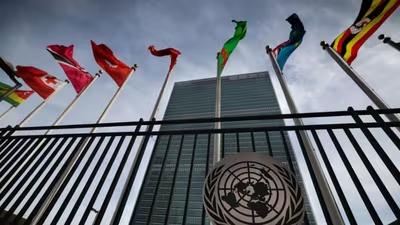
It has been 81 years since the United Nations Security Council was established in 1945, in the aftermath of World War II.
Since then, its permanent membership has remained unchanged; China, France, Russia, the United Kingdom and the United States hold the five permanent seats, each with veto power.
Apart from the five permanent members, the Council currently has 10 non-permanent, rotational members. India officially put forward its candidature for a permanent seat in the Security Council during the 49th General Assembly in 1994. It is important to note here that the composition of the UNSC has been expanded only once since its creation in 1945. An amendment to the UN Charter in 1965 increased its membership from 11 to 15 by adding four non-permanent seats. external affairs minister S Jaishankar highlighted that India has contributed nearly 300,000 personnel to about 50 UN peacekeeping missions since the organisation’s inception—and currently has over 4,300 personnel serving in 10 UN peacekeeping missions While launching a campaign for India’s election as a non-permanent UNSC member for the 2028-29 term. The 10 non-permanent members are elected by the UN General Assembly for two-year terms. 2026: Denmark, Greece, Pakistan, Panama, Somalia 2027: Bahrain, Colombia, Democratic Republic of the Congo, Latvia, Liberia Australia will bid to join the United Nations Security Council from 2029, Prime Minister Anthony Albanese has said, as he launched a campaign to secure one of the two non-permanent seats available to its bloc. India has served as a non-permanent member of the UN Security Council eight times: first in 1950–51, followed by terms in 1967–68, 1972–73, 1977–78, 1984–85, 1991–92, 2011–12 and most recently in 2021–22. New Delhi has officially launched its campaign for election as a non-permanent member of the United Nations Security Council (UNSC) for the 2028-29 term. Its official campaign for the two-year term is “Shanti: India for the United Nations Security Council 2028–29 — Norms, Trust, Integrity. Each of the 15 members of the Security Council has one vote. The UN Security Council was established in 1945, when the United Nations was created in the aftermath of World War II. The UN Charter, which established the Council, was signed on June 26, 1945, and came into force on October 24, 1945. The Security Council held its first meeting on January 17, 1946, at Church House, Westminster, London.
Because a substantive resolution cannot be adopted if even one of the five permanent members votes against it, provided the resolution otherwise requires the permanent members’ concurrence, a veto is particularly significant. New Delhi has called for an expansion in both the permanent and non-permanent categories of Security Council membership. It has also cautioned that expanding only the non-permanent category would not fundamentally alter the Council’s decision-making structure, which gives the five permanent members a special position. The five permanent seats remained unchanged. India argues that the global order has changed significantly since the UN’s early days and that developing countries should have greater participation in global decision-making. India has consequently maintained that reform of the Security Council can no longer be delayed. India also points to its size, democratic system, growing economic and geopolitical weight, and contribution to UN peacekeeping as part of its case for a permanent membership. He added that India has consistently advocated dialogue and diplomacy and has sought to give voice to the concerns of the Global South. Across these terms, India has participated in the Council’s deliberations and decisions on international peace and security, including on issues ranging from conflicts and peacekeeping to sanctions and international cooperation. Amongst the five permanent members of the Council, four have long supported India’s bid. However, the five permanent members – China, France, Russia, the United Kingdom and the United States – have veto power over substantive decisions. Under the UN Charter, all member states are obligated to comply with Security Council decisions. If India gets a permanent seat on the UN Security Council, it would also gain veto power as the existing five. In other words, a single veto from a permanent member can block a substantive resolution, regardless of how many other members support it.
At the UN Millennium Summit in New York in September 2000, then Prime Minister Atal Bihari Vajpayee had reiterated India’s case for permanent membership, saying that India had “let it be known for some years” that it considered itself qualified for the responsibilities of permanent membership. However, China has not explicitly backed India, even though said it was in favour of it during the recent BRICS Summit and other occasions.
Since then, it has reiterated its candidature at all the subsequent UN General Assemblies. This would give India a more substantial say in major global issues before the Council. India has been pitching for a permanent seat while calling for an expansion of the UNSC to make it more representative of today’s world, with greater participation from Asia, Africa and Latin America.
The Security Council also has a presidency, which rotates among its 15 members every month. The decision to first review the question of Security Council restructuring was first taken at the 47th General Assembly in 1992 following which an Open Ended Working Group (OEWG) to review all aspects relating to Security Council restructuring was established in 1993. it has not yet been possible to arrive at any agreement on the key questions of size of an expanded Council, models for expansion, or criteria for candidatures Although the OEWG has been discussing the issue since 1993. Back in 2002, eight years after India first bid itself for a permanent seat, nine countries had expressed support in the UN for India’s candidature.
The Security Council takes the lead in determining the existence of a threat to the peace, breach of the peace or act of aggression. It calls upon parties to a dispute to settle it by peaceful means and recommends methods of adjustment or terms of settlement. In some cases, the Security Council can impose sanctions or even authorise the use of force to maintain or restore international peace and security. India’s bid for a permanent seat has secured support from several major countries, strengthening its case for a greater role in the Council. Recently, at the BRICS Summit held in New Delhi, China and Russia (two permanent UNSC members) reiterated their support for the aspirations of Brazil and India to play a greater role in the UN, including its Security Council. The BRICS leaders also reaffirmed their commitment to reforming the UN Security Council to make it more democratic, representative, effective and efficient, with greater representation for developing countries. American economist Jeffrey Sachs has also thrown his weight behind India, saying no other country has as strong a claim to become the sixth permanent member of the UNSC than India. These countries are Mauritius, Bhutan, Cuba, Dominican Republic, Russia, Vietnam, Laos, Cyprus and Cambodia. Cyprus also recently reiterated its firm support for India’s permanent membership of a reformed UNSC. Palestine has also publicly backed New Delhi’s long-standing aspiration for a permanent seat.
“Think of all countries in the world, there is no country other than India that has such a strong claim as the sixth permanent member of the UN Security Council,” Sachs said in an interview with news agency PTI. Sachs also called on India and China to work together to overcome their differences and said Beijing should support New Delhi’s bid.
