
Dear Reader,
She takes us to a whole cast of compelling characters: Sardar, the wedding photographer; Dr Tariq, who runs the de-addiction centre; Saleem Shaheen, the actor-director of Bollywood lookalikes; and Zafar, the archaeologist. Khan chooses well, and each tells their own story as well as the story of the country: the destruction of Buddhism, poppy cultivation and drug addiction, and relationships between men and women.
My favourite part was Taran Khan’s search for books. She trawls the city’s high-end cafés for books to swap, and finally discovers a bookstore. Khan becomes friendly with the bookseller Shah Muhammad Rais, a man with a love of books, with liberal views, a man who is jailed because he stocks books and political tracts from opposing sides: the Communists, the Taliban.
There is another bookish story here – the bookseller is smarting because a Norwegian journalist named Åsne Seierstad asked to write a book about him. The bookseller agreed, welcoming Seierstad into his house, where she lived with his family for months. And then she wrote the bestselling The Bookseller of Kabul.
Rais was furious about the book; it portrays him as a man who may be liberal in some ways but is harsh and unjust in his home life.
So, of course, I had to read The Bookseller, which I found to be a racy potboiler that begins with the fifty-year-old bookseller’s search for a second wife. It’s sensational, written through a fiery feminist lens in which the bookseller emerges as a vain villain rather than a complicated man shaped by his time.
Rais doesn’t stock The Bookseller of Kabul in his shop. Instead, he wrote his own version of the story titled Once Upon a Time There Was a Bookseller in Kabul. Two versions of the same story. And no prizes for guessing which version is more widely available. I tried to find a copy of the bookseller’s rebuttal but failed.
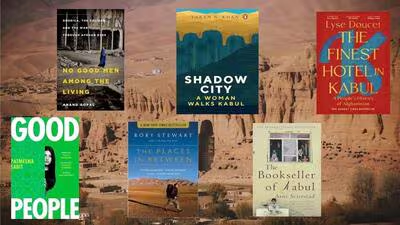
And yet The Bookseller of Kabul is a clever way of telling history: using one family’s story to illuminate a larger culture. If you like this narrative lens, read Good People by Patmeena Sabit, about an Afghan-American family in Northern Virginia. The novel uses a murder-mystery format, with multiple points of view across generations and cultures, to examine the tensions within Afghan-American culture through the death of a young girl.
Zooming out from individual families to the Afghan landscape is The Places in Between by Rory Stewart. Former British diplomat Rory Stewart takes a solo walk across Afghanistan in the winter of 2002, following the route of the 16th-century emperor Babur. Stewart uses a deeply historical and anthropological lens, focusing on rugged geography, rural isolation and the complex web of local tribal politics. He finds an unexpected companion on the way and even sketches people, places and objects he encounters.
And then there is No Good Men Among the Living by Anand Gopal. He weaves together three lives, a Taliban commander, a US-backed warlord and a village housewife, following them in parallel through the post-9/11 war. Gopal is sharply critical of US policy. His story is gritty, with the feel of fear and confusion of constantly shifting alliances in a war zone.
I still haven’t been to Kabul. But between these six books and rooms and screens full of readers arguing over which version felt truest, I’ve travelled further than I expected an armchair to take me. And I’ve been reminded again of the magic of stories told in different ways. I’ve also been struck by the strange irony that some of the best-known stories about a place are told by outsiders. And realized why we always need to read more than one version. Six shards of refracted glass, perhaps, for a better picture.
Sonya Dutta Choudhury is a Mumbai-based journalist and the founder of Sonya’s Book Box, a bespoke book service. Each week, she brings you specially curated books to give you an immersive understanding of people and places. If you have any reading recommendations or reading dilemmas, write to her at [email protected]. The views expressed are personal
Because it was a book about Afghanistan but was set in a five-star hotel, “I was drawn to it precisely. Because you kind of expect to see the city through a series of walks, so there isn’t much actual walking in the book, which is disappointing. I am in Afghanistan. The land once conquered by Babur, founder of the Mughal dynasty. The land of the destroyed Bamiyan Buddhas, of craggy peaks and hostile terrain, fought over by superpowers, clans and tribes, mujahideen and the Taliban. And I am here in a unique way: as an armchair traveller. Now I have these six books in my head. Each is like a piece of gloriously coloured broken glass in a kaleidoscope, reflecting some reality and obscuring some too. Each does it differently, and I am marvelling at how stories can tell us so much and yet, inevitably, leave so much out. This last week I have been in the middle of the Inter-Continental Hotel, set high on a hill, the setting for BBC journalist Lyse Doucet’s Women’s Prize for Non-Fiction-winning The Finest Hotel in Kabul. She gives us a vertical slice of more than five decades of history — civil war, the Soviet occupation, the US invasion and its aftermath, all seen through one hotel. Ever since Arthur Hailey’s Hotel, through The Grand Budapest Hotel and, more recently, A Gentleman in Moscow, stories set in grand hotels seem to have caught the popular imagination. For me, the five-star hotel felt like a gilded cage: there was so much focus on the chandeliers and red velvet armchairs, and so many characters came and went. I did love some of them, like nineteen-year-old Amanullah, the guard outside the hotel, and Abida, the middle-aged chef, but there were so many characters coming and going that I couldn’t connect with many of them. And yet telling the history of a city or country across five decades through a single iconic building is such a clever way to do it. And thinking about it, that made total sense to me. From The Finest Hotel in Kabul, I moved to Shadow City: A Woman Walks Kabul by Taran Khan. Khan is connected to Afghanistan through her Pathan ancestors, and through her grandfather, who loves the poetry of Bedil and Rumi, whose words teach her how to explore the city While Lyse Doucet is a war correspondent. Khan’s style of storytelling is quite different from Doucet’s. She chooses to stay visible; she tells us about herself — growing up in Aligarh, where going for walks was not really a thing for girls, and about her ancestors, who probably came from Kabul. In Kabul, too, everyone insisted that she shouldn’t walk. Khan explores the city as a living, breathing, recovering urban space. She maps the city through its libraries, cinemas, gardens and ruined architectural layers.
I didn’t feel like reading the same sad, gritty war-on-the-streets stories,” said N at our discussion.
Last year and again this year, our book clubs set ourselves the task of understanding Afghanistan through books.
