
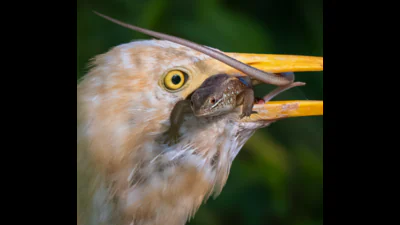
In his ongoing series of hunting-action photographs from the Saketri grasslands east of the Sukhna lake, Anuj Jain captured a vivid contrast of emotional expressions.
Photographing wildlife can be educative if the lensman is observant rather than one merely interested in clicking a proverbial “pretty picture”.
The temple priest spotted the snake and mistook it as a non-venomous rat snake. But choosing discretion over valour, he summoned the rescue team of Wildlife SOS. After methodically clearing and shifting a substantial amount of material, the team located the hiding cobra. “Despite the challenging circumstances and confined surroundings, the cobra remained unusually calm throughout the rescue operation allowing our trained team to safely secure and contain it. Like mature humans, who maintain a sober approach in critical situations, the cobra remained calm. Also, our rescue team is experienced and it handled the cobra with a deftness that ensured the snake did not panic and get aggressive. If not handled adroitly, cobras have wrapped the tail around the rescue personnel’s hand/arm and manoeuvred to deliver a bite. By resort to bouts of harmless hissing and flaring of hood, the cobra delivers ample warning to keep away. In contrast, a common krait will bite without a warning hiss or a pronounced display such as a flared hood. Even the viper will retreat into ‘jalebi-like’ coils and vocalise hisses so pronounced that they mimic a pressure cooker’s warning whistles of being done with delicious ‘rajmas’ for lunch!
I assess that the cobra’s calm demeanour was due to it being an adult.
In contrast, juvenile cobras can be very aggressive,” Baiju Raj MV, Director, Conservation Projects, Wildlife SOS, and a veteran snake rescue expert, told this writer. That said, a cobra is generally reckoned a ‘’good snake’’.
