
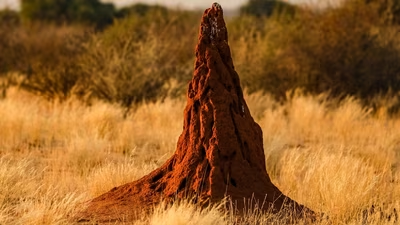
Some African termites build mounds that rise more than five meters above the ground, creating towering structures around their colonies. Coral reefs extend for many thousands of kilometers. Spider silk can be stronger than steel by weight. None of these creatures can draw blueprints, but they can still produce structures that are highly sophisticated from an engineering perspective. How animals achieve this has been a subject of scientific study for decades, with researchers examining how simple individual actions can give rise to complex structures.
Dartmouth College behavioral ecologist Mark Laidre examined that question in a review published in Current Biology , drawing together research on how animals from termites to hermit crabs shape and modify their physical environments. The review describes how complex animal architecture can emerge from the behavior of individual builders, while research on social insects shows how local cues and interactions can produce coordinated structures without centralized control. Termite nests put that principle to a striking test. Researchers Alexander Heyde, Lijie Guo, Christian Jost, Guy Theraulaz and L. Mahadevan examined the intricate underground nests of the African termite Apicotermes lamani. In a study published in the Proceedings of the National Academy of Sciences , the team used CT scans to document the nests’ internal architecture, revealing parallel floors connected by linear and helical ramps. They then developed a mathematical model to explore how interactions among termite behavior, pheromones, and mud could generate this organized structure through a physical feedback process. The findings, the authors noted, could inform research on swarm intelligence and the use of self-organizing principles in architectural design. Building on this scale is not cheap. Honeybees pour months of colony labor into their wax combs, and naked mole rats can expend substantially more energy tunnelling through packed soil than they would moving across open ground. The return on that investment can outweigh the cost. A well-built shelter can regulate temperature, store food, protect young, and attract a mate, often all at the same time, which is partly why some animals skip construction altogether and simply move in. Hermit crabs occupy shells built by snails, and one highly social species takes it further still, remodeling the interior to fit crab life and effectively creating a housing market of reusable homes passed down across generations. Beavers go the opposite route, reshaping entire rivers with dams that reorganize the plants and animals living nearby for years afterward. Some termite mound sites can persist for centuries or even millennia, far longer than the lifespan of any individual termite, as successive colonies may recolonize and modify them.
All the complexity arises through thousands of small interactions between animals and their environment, not due to a single plan or idea. What all these examples have in common is that they seem not to be designed by any mastermind, but rather represent a process in which individual animals respond to one another and their surroundings until something remarkable emerges. So next time you see an ant colony that seems unremarkable, take a second look. It might be a tangible representation of complexity arising out of simple behaviors.
