
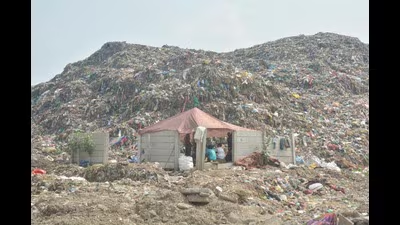
Punjab’s long-festering legacy waste crisis continues to cripple its urban local bodies (ULBs), with 41.11 lakh metric tonnes (MT) of old municipal garbage awaiting remediation. The environmental disaster has repeatedly drawn the National Green Tribunal’s (NGT) wrath—triggering heavy compensation penalties—while complete cleanup is now pushed to April 2027.
The crisis is most acute in Amritsar, Ludhiana, Jalandhar, Mohali, and Sangrur. These five districts account for the bulk of the state’s total accumulation, a direct consequence of relying on unscientific open dumping rather than processing. Legacy waste comprises refuse accumulated at dumpsites over years, including municipal garbage. The prolonged presence leads to environmental risks through leachate, landfill fires, air pollution, and contamination of soil and groundwater, besides placing a continuing financial and administrative burden on ULBs. Environmentalist and Rajya Sabha member Balbir Singh Seechewal demands strict enforcement and structural reform. “The priority must be fixing accountability. Waste must be segregated and processed at every stage. Decentralised processing: Establish ward and cluster-level composting plants and MRFs with strict district processing targets. Informal sector integration: Map informal waste pickers via a statewide census and integrate them into official municipal collection/recycling cooperatives. Bhagtanwala (Active): Accounts for most of the waste. However, its proximity to the Golden Temple makes it an environmental hazard. Chalo Amritsar campaigner Samita Kaur demanded its time-bound removal, citing major environmental risks. Petitioner Kapil Dev blamed the mounting trash directly on the administration’s failure to implement tribunal orders.
Financial transparency: Launch a public state dashboard tracking solid waste management (SWM) funds, spending, and actual processing outcomes across all 166 ULBs. DISTRICT BREAKDOWN AMRITSAR 3.73 lakh MT waste rots in holy city Despite ₹ 8 crore in PPCB penalties and continuous NGT oversight, Amritsar remains buried under 3.73 lakh MT of legacy waste spread across Bhagtanwala, Chabbal Road, and Chheharta. The city daily adds nearly 700 MT of fresh garbage to this burden. Bio-remediation began on October 2, 2025, clearing 8.38 lakh MT by late September 2026. Defunct dumpsites: Chabbal Road (1.37 lakh MT, abandoned for 25 years) and Chheharta (57,273 MT, abandoned for 35 years) remain untouched. Deadlines: MC commissioner Bikramjit Singh Shergill says tenders are complete, targeting remediation by March 2027 (Chabbal Road) and December 2027 (Chheharta). LUDHIANA 27 illegal dumpsites defy cleanup Ludhiana generates 1,100 MT of fresh waste daily but can process only 300 MT at its Jamalpur facility. This gap has built a 24-lakh-MT mountain of legacy waste across Jamalpur and Jainpur. NGT crackdown: The NGT has summoned the deputy commissioner, MC commissioner, and PPCB member secretary to appear on October 7, 2026, after the city failed to clear 27 illegal dumpsites identified three years ago. Path ahead: MC joint commissioner Vineet Kumar expects processing rates to increase from 1,600 MT to 3,000 MT daily post-monsoon. JALANDHAR Bio-mining lags, PPCB fails to recover fines Jalandhar sits on 7.14 lakh MT of legacy waste at Wariana, while generating 600 MT of fresh daily garbage. Unpaid penalties: The NGT reprimanded the PPCB on August 12 for failing to recover ₹ 8.4 crore out of a ₹ 9.3 crore penalty slapped on the Jalandhar MC. Slow progress: Against an 8-lakh-MT target for phase one bio-mining, the MC has processed just 86,000 MT. Though awarded in August 2024, the plant became operational only in November 2025. The 32-month project faces a January 2028 deadline. A second 11-lakh-MT project is being planned.
Processing delays: Bio-mining at Jamalpur, awarded in December 2024, started only in April 2026 due to power and weather delays, processing 1.8 lakh MT by June 2026.
Erring officials must face action, and available funds must be deployed efficiently to break this endless cycle,” he said, recommending the following steps: Service-linked enforcement: Enforce household-level segregation only after ULBs provide door-to-door collection, partitioned transport, and functioning material recovery facilities (MRFs).
The scale of the problem keeps shifting. Legal scrutiny has been relentless. The state neither opened the account nor deposited the penalty. A widening gap between rapid urbanisation and abysmal waste-management infrastructure drives the crisis. Systems for collection, segregation, and scientific processing have failed to keep pace. Crucially, poor source segregation creates mixed, contaminated waste that is far harder to bio-mine, guaranteeing it ends up on mountain-high dumpsites. Fix accountability
While Punjab’s 166 ULBs initially reported 84.09 lakh MT of legacy waste—claiming 43.47 lakh MT had been remediated—an NGT-mandated audit forced authorities to add previously unaccounted waste stock. The balance consequently shot back up to 41.11 lakh MT, according to a state compliance affidavit filed before the tribunal recently. In September 2022, the NGT imposed a ₹ 2,080 crore environmental penalty on Punjab, ordering the money into a ring-fenced account. In July 2024, the NGT slapped a fresh ₹ 1,000 crore fine over legacy waste and untreated sewage management failures, noting Punjab repeatedly failed to take “serious, substantial and urgent steps. In September 2024, the Supreme Court stayed the ₹ 1,000 crore penalty. With over 41 lakh MT still rotting on the ground, Punjab faces a dual challenge: Clearing decades of legacy filth while processing daily fresh waste to stop creating new landfills.
MOHALI Airport risk leaves city without solution Two decades in, Mohali that generates 150 MT daily waste lacks a permanent processing facility, leaving 8,000 MT of legacy waste untreated. Stalled projects: The original Phase 8-B site holds lingering waste despite 90% bio-mining claims. The long-delayed Samgoli project, conceived in 2012, remains stalled after 14 years, with local politicians, including Dera Bassi MLA Kuljeet Singh, opposing a plant set up in their jurisdictions. SANGRUR Waste doubles, DC summoned A March 2026 survey nearly doubled the legacy waste estimate from 7,427 MT to 15,961 MT. Only 7,500 MT has been remediated, leaving 8,461 MT untreated at the Ubhawal Road dumpsite. The NGT has summoned Sangrur’s deputy commissioner to appear on November 18, 2026, over an unpaid ₹ 84-lakh penalty and unconsented operations. Contractor delays: Awarded to Triple R Infratech in February 2026, the project missed its original September 30, 2026 deadline—officials cited monsoon rains, scope approval delays, and logistics. So far, 804.51 MT of refuse-derived fuel (RDF) has been offloaded, while bio-soil is earmarked for low-lying areas in Sangrur and Kammo-Mazra. Civic authorities have missed the September 2026 deadline and sought an extension to March 31, 2027.
Airport hazard: A temporary 150-tonne processing facility at Jagatpura (set up in March 2025) has hit rock bottom due to resident protests, industrial buyers halting RDF off-take, and bird-strike warnings from airport authorities. Civic apathy alleged: The site lacks mandatory PPCB environmental clearances. NGT petitioner Kamal Anand cites official apathy, pointing to open burning, defunct compost pits, littered streets, and unchecked biomedical waste.
MC commissioner Surinder Singh says the first project is progressing according to schedule and that the second project will help address the problem in a phased manner. MC commissioner Sandeep Singh Garha says efforts to establish proper solid-waste processing facility on.
