
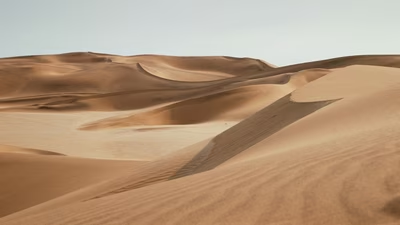
There are accounts of odd noises coming out of some of the sand dunes dating back to ancient times. During his journey through the Gobi Desert in Asia in the 13th century, Venetian merchant and explorer Marco Polo wrote about music made by ghosts, which he believed were desert spirits. It is an extraordinary natural occurrence that goes by the names of singing or booming sands.
French physicist Bruno Andreotti offered one of the clearest explanations for what happens inside that avalanche. Those vibrations can then couple to the air as sound. They also documented that the sound often keeps resonating for a while even after the sand itself has stopped moving, a detail the review discusses in terms of the dune’s near-surface structure helping support and amplify the vibrations, allowing the sound to persist rather than disappearing immediately when the avalanche ends.
In a 2002 paper titled The Song of Dunes as a Wave-Particle Mode Locking , published in Physical Review Letters, he showed that as sand grains tumble downhill, their collisions send elastic waves rippling through the dune’s surface layer. Andreotti’s measurements found that the loudness caps out at around 105 decibels, at the point where the shaking becomes strong enough to briefly lift grains off the flowing layer. Their survey counted close to 40 known singing sites around the globe, with a dominant frequency band of roughly 70 to 110 hertz and fainter higher harmonics layered on top.
