
Today, Daayra takes that iconic line and turns it into a meticulous drama about whether law and justice are really players on the same team, or often find themselves on opposite sides. It’s been 33 years since Sunny Deol famously thundered on screen, “Tareekh pe tareekh milti gayi, My Lord, par insaaf nahin mila! But does it pack the same punch as Sunny paaji’s legendary courtroom outburst? Let’s find out.
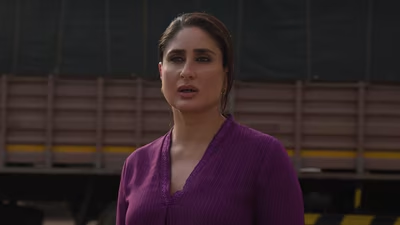
Daayra begins as an investigation drama, with Meghna’s screenplay taking its own sweet time to allow the interrogations and procedures to play out, as Ajooni pieces together what really happened during the encounter. The measured approach lends the film a certain authenticity, although it also means the narrative takes some time to gather momentum. At times, the film appears caught between the grammar of a mainstream Hindi thriller and the restraint of a serious drama. There is an unmistakably filmi quality to some of the characterisations. Kareena, for instance, brings a distinct screen presence to Ajooni, although some of her lighter expressions can feel slightly at odds with the gravity of the investigation. I also find the choice of her name, Ajooni, interesting in this context. Whether there is a deeper intention behind the name or it is simply a character choice, the film doesn’t spell it out. The first half is deliberate rather than gripping. The subject is important, and what works in the film’s favour is its willingness to let the investigation breathe. The procedural drama is given room to play out instead of being rushed from one revelation to another. The trade off, however, is that the film sometimes lacks the urgency one would expect from such a disturbing case. The second half picks up pace and moves towards its climax. there are enough compelling moments along the way to keep you invested While the conclusion may not come as a complete surprise. The film’s strength lies less in shock value and more in the questions it raises about institutions and accountability. A wise choice on the makers’ part is to keep the film largely free of music, barring a B Praak song that plays over the end credits. It works in the film’s favour, allowing the narrative and its grim subject matter to remain at the forefront without musical interruptions.
The word appears in the Ik Onkar, “Ajooni saibhang”, broadly referring to one who is beyond birth and death, self-created.
The verdict
Overall, Daayra raises a question far more uncomfortable than the one it begins with: when the system itself becomes part of the story, where does justice really begin? The film has enough moral complexity to make that question linger, even if its trajectory and pace blunt some of its impact. By the time the end credits roll, you are left with a film that has substance and clearly wants to provoke thought, but could have used a little more fire to truly leave a mark.
