
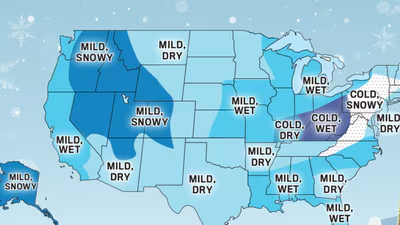
The Old Farmer’s Almanac has released its 2026-27 winter outlook, and the Northeast could see a sharp split in temperatures and snowfall. The southern part of the Northeast is expected to be colder and snowier than normal, while northern areas could be warmer with less snow. The Atlantic Corridor is set for a milder winter, with above-normal temperatures and slightly below-normal snowfall. The Appalachians are also expected to turn colder and snowier, especially in the north. The forecast comes as a strong El Nino develops in the Pacific, a pattern that can affect winter weather across the US.
Appalachians forecast
NOAA’s Climate Prediction Center said on September 10 that El Niño is strengthening and there is a greater than 90% chance of a very strong event during the Northern Hemisphere fall and winter of 2026-27. The southern part of the Northeast is expected to have below-normal temperatures and above-normal snowfall this winter . The northern part of the region has a different outlook, with temperatures expected to be above normal and snowfall below normal. The Old Farmer’s Almanac lists early and mid-January as the coldest periods for the Northeast. Snow is expected to be most frequent around mid- and late December, mid-January, and early and late March. Precipitation overall is forecast to be below normal. That means the winter pattern could vary considerably even within the same region. Areas farther south may deal with more cold and snow, while northern parts could have a milder season. The Atlantic Corridor is expected to have a milder winter than the colder parts of the Northeast. The Old Farmer’s Almanac forecasts above-normal temperatures, below-normal precipitation and slightly below-normal snowfall. The snowiest periods are expected in late November, early and mid-January, early and late February, and late March. The forecast also identifies early to mid-December, early to mid-January and early and late February as the colder stretches. So, while snow remains part of the forecast, the season is expected to be warmer overall and bring slightly less snow than usual. The Appalachians are expected to see colder conditions, with snowfall above normal, particularly in northern areas. Precipitation is forecast to remain below normal across the region. Mid-January and mid- to late February are expected to bring the coldest periods. The main snowier stretches are forecast for mid-January and early and late February. The regional forecast fits into the wider winter pattern outlined by the Old Farmer’s Almanac, which expects colder and snowier conditions from central New England through the Appalachians and into the Ohio Valley. A major factor behind this winter outlook is El Nino .
