
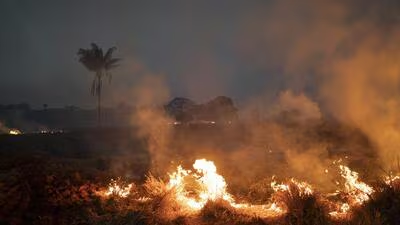
Following a 54% drop in stubble burning cases during the last kharif season, Punjab is set to deploy drones for the first time this year to keep a strict eye on every fire incident related to paddy straw across the state. Last year, the state recorded 5,114 cases of stubble burning, down from 10,909 in 2024.
The Commission for Air Quality Management (CAQM) in the National Capital Region and adjoining areas has already directed the state government and the Punjab Pollution Control Board (PPCB) to ensure drone surveillance in identified stubble hotspots. Paddy harvesting is expected to gather momentum from October 10. As the PPCB started monitoring the stubble burning cases, two such fire incidents were recorded on September 15 in Tarn Taran district. The state government has spent nearly ₹ 300 crore in providing crop residue machines under centrally sponsored Crop Residue Management Scheme, besides spending ₹ 26.31 crore on information, education and communication activities for farmer education, field demos and digital advisories, according to the comprehensive action plan.
“We have received instructions from the CAQM on drone deployment to strengthen monitoring and regulatory enforcement. At present, the PPCB monitors stubble burning through the Punjab Remote Sensing Centre. However, the CAQM noted that while overall fire events have reduced under standard monitoring, late-evening burning has reportedly emerged as a tactic to evade satellite passes. “The alleged practice of burning paddy stubble in late evening hours to evade satellite tracking calls for a strengthened surveillance mechanism. The commission mandated that drone surveys operate during the day, with focus on late evening hours—specifically targeting the 3pm to 9pm window. UAVs will map active fires and burnt traces against local cadastral maps, ensuring lawful, safe, and systematic geo-tagging and documentation. Eight high-risk districts In a comprehensive compliance plan submitted to the CAQM, the PPCB identified eight high-risk districts: Sangrur, Ferozepur, Bathinda, Moga, Muktsar, Mansa, Tarn Taran, and Faridkot.
These eight districts accounted for 3,454 of the state’s total 5,114 cases last year—contributing 67% of the total fire incidents. Punjab has nearly 31 lakh hectares dedicated to paddy cultivation and expects to generate about 18.81 million tonnes (MT) of paddy straw this season, compared to 19.52 MT last year. The state has seen a multi-year downward trend in crop residue burning, recording a 70% drop in 2024 (10,909 cases) compared to 2023 (36,663 cases).
Rajeev Kumar, superintending engineer (SE) at PPCB and state nodal officer for stubble burning, said that drones will serve as an effective tool to catch stubble burning occurring during late evening hours, which previously went undetected by satellite monitoring. We are chalking out a detailed operational plan and briefing district administrations on standard operating protocols to ensure drone surveys, if required at their level, in red hotspot areas,” he said. Tighter surveillance The CAQM said that undetected late-evening burning demands tighter surveillance through unmanned aerial vehicles (UAVs). UAVs will enable timely detection and enforcement,” the CAQM directive said. Senior officials said this marks the first time drones will be used to track stubble fires in the state.
Drones were previously restricted to monitoring government infrastructure schemes, digital aerial surveys of mining sites, and high-resolution imaging for highway projects.
Paddy straw burning in Punjab and Haryana remains a major driver of winter air pollution in Delhi-NCR. To address this, the state advanced paddy sowing and harvesting dates, giving farmers more time to clear fields without burning. To ensure ground-level enforcement, the state government has deployed 12,000 employees from various departments as district nodal officers, cluster coordinators, and field personnel to report fires in real time. 1,963 FIRs registered last year A total of 1,963 FIRs were registered last year against farmers in Punjab for burning stubble under the Section 223 (disobedience to order duly promulgated by public servant) of Bharatiya Nyaya Sanhita (BNS). The state had imposed an environmental compensation of ₹ 1.25 crore in 2,386 cases. The government made red entries in the revenue records of the farmers in 2,176 cases. Farmers having an agricultural land of less than two acres shall be liable to pay ₹ 5,000 per stubble burning incidence against ₹ 2,500 earlier, according to the CAQM. Meanwhile, those with two acres or more but less than five acres would pay ₹ 10,000 against ₹ 5,000 earlier. Cultivators having land of more than five acres shall pay an environmental compensation of ₹ 30,000 per incidence.
Because the time window between paddy harvest and wheat sowing is narrow, farmers often burn crop residue to clear fields quickly.
