
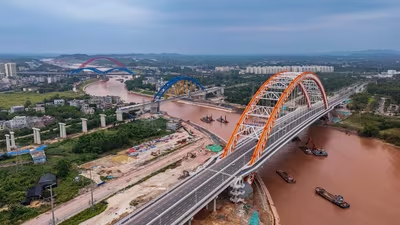
The 134-kilometre Pinglu Canal, opened on Wednesday, took four years to build and cost 72.7 billion yuan.
China has opened a major canal, which aims to act as a “trade shortcut” between its landlocked regions and Southeast Asia.
The key route will link Nanning, in the southern manufacturing region of Guangxi, to the Gulf of Tonkin, which is flanked by China and Vietnam. The canal, which comes as China seeks to deepen and strengthen its ties with the Southeast Asian region in the wake of the tensions in West Asia, is the first such ‘man-made canal’ to be built since the founding of the PRC in 1949.
State broadcaster CCTV shared footage of the first barge to pass through the canal and aerial video of ships navigating its calm waters, calling the waterway as “the project of our century”.
AS per a report by the South China Morning Post , total trade between China and ASEAN nations reached US$862.75 billion in the first eight months of 2026, up by 25.6 per cent from the last year.
How is it a “trade shortcut”?
As per Xinhua , the journey of goods from Guangzhou to the sea has been reduced by at least 560 kilometres. The state agency added that costs are expected to be cut by 18 to 30 per cent. This cut in transport costs is also expected to save more than five billion yuan ($745 million) in the sector.
The government also promised jobs at the construction site and vocational training for residents who have been asked to relocate due to the canal. The waterway will act as a major trade shortcut due to a much shorter journey. Furthermore, due to a shorter distance, the transport costs have also been cut.
The canal is part of the New International Land-Sea Trade Corridor, which, in turn, comes under President Xi Jinping’s Belt and Road Initiative, which seeks to connect China to Europe and Africa. The construction of the canal also resulted in the resettlement and relocation of thousands of families. As per Al Jazeera , thousands of families in Guangxi, Hengzhou, were asked to evacuate and relocate. To reduce the stress caused to the displaced families, China offered financial compensation along with housing, which was designed in accordance with the customs of the residents. The new route will also be important for rural parts of Sichuan, Chongqing and Yunnan, among others, which are less connected than eastern China regions. Additionally, coal, ore, cereals, chemicals, agricultural produce and other materials will now be able to reach foreign markets more easily. The opening of the canal has led China to seek to deepen its ties with ASEAN countries in the wake of the rising tensions in the West Asia region. With the Pinglu Canal, China seeks to strengthen its supply chains and economic ties with ASEAN, which continues to be among China’s largest trading partners.
