
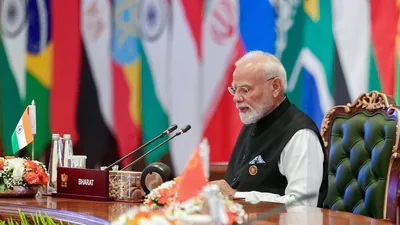
BRICS leaders on Saturday unanimously adopted the New Delhi Declaration at the 18th Summit in New Delhi. Follow updates on Day 2 of the BRICS Summit The document outlined the group’s position on global conflicts, terrorism, trade, climate, technology and development.
Nuclear facilities: BRICS showed serious concern over attacks on civilian infrastructure and peaceful nuclear facilities under IAEA safeguards. UN Security Council reform: China and Russia backed India and Brazil’s aspirations for a greater role in the UN, including the Security Council. Gaza ceasefire: BRICS called for an Israeli ceasefire in Gaza and full, unhindered humanitarian access. No forced displacement: The grouping opposed the forced displacement of Palestinians, whether temporary or permanent and under any pretext. Two-state solution for Palestine: BRICS backed Palestine’s full UN membership. Tariffs: BRICS raised serious concerns over rising unilateral tariff and non-tariff measures. Protectionism: The grouping opposed protectionism presented as environmental policy. Sanctions: BRICS condemned unilateral economic sanctions and secondary sanctions. Carbon border taxes: BRICS opposed unilateral, punitive, discriminatory and protectionist measures such as carbon border adjustment mechanisms when they do not comply with international law. WTO reform: BRICS reaffirmed support for WTO reform. It backed an open, transparent, fair, inclusive and rules-based global trading system with the WTO at its core. Developing countries: The declaration reaffirmed the principles of Most-Favoured-Nation Treatment and Special and Differential Treatment for developing countries, especially least developed countries. Local-currency payments: BRICS backed greater interoperability between cross-border payment and messaging systems. It also encouraged trade and investment settlements in BRICS local currencies, while respecting national priorities. BRICS Risk Lab: Members showed interest in India’s proposal to set up a BRICS Risk Lab at GIFT City’s International Financial Services Centre in Gujarat. Insurance resilience: The proposal comes under a voluntary BRICS Insurance Resilience Centre. It aims to develop common risk models, share best practices and build specialist capabilities. Reinsurance: BRICS members also agreed to continue discussions on strengthening their reinsurance capacity. AI governance: BRICS committed to implementing the BRICS Leaders’ Statement on Global Governance of Artificial Intelligence. Lebanon: BRICS called on Israel to respect its agreements with the Lebanese government and withdraw its occupying forces from Lebanese territory. UNIFIL peacekeepers: BRICS expressed condolences over the deaths of four Indonesian peacekeepers and other personnel serving with the UN Interim Force in Lebanon (UNIFIL). Big cats: BRICS endorsed India’s initiative to create an International Big Cats Alliance. It encouraged member countries to cooperate on big-cat conservation.
Pahalgam attack: BRICS strongly condemned the April 22, 2025 terror attack in Jammu and Kashmir. The attack killed 26 people and injured many others. It called for support for a two-state solution based on the 1967 borders, with East Jerusalem as the capital of Palestine.
The 140-point declaration, titled “New Delhi Declaration — Building for Resilience, Innovation, Cooperation and Sustainability,” backed India and Brazil for a bigger UN role, opposed the Israeli war in Gaza, pushed for local-currency trade and endorsed India-led initiatives on financial risk, AI and big-cat conservation. It said such attacks violate international law and IAEA resolutions. It said such measures distort trade and conflict with WTO rules. It said it opposed sanctions not authorised by the UN Security Council.
