
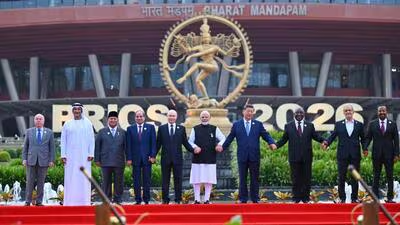
Underlining that energy security was essential for economic growth, Brics member states on Saturday declared that while fossil fuels would continue to play a crucial role in emerging and developing nations, energy transitions must be “just, orderly, and equitable.”
In their New Delhi summit declaration , the leaders also launched a sharp critique against unilateral trade-restrictive measures, explicitly rejecting the European Union’s carbon border adjustment mechanism (CBAM), which they said was a protectionist hurdle for emerging economies. Acknowledging growing disasters, including those linked to climate change, the countries reaffirmed their commitment to Brics cooperation to improve national disaster risk reduction systems while mobilising accessible, predictable and adequate financing. “This includes its provisions related to mitigation, adaptation, loss and damage and the provision of means of implementation to developing countries, reflecting equity and the principle of common but differentiated responsibilities and respective capabilities, in light of different national circumstances. Amid growing global volatility in the energy sector, the declaration called for enhanced energy security—by ensuring energy market stability and maintaining uninterrupted flows of energy from diverse sources, strengthening value chains, and ensuring the resilience and protection of critical energy infrastructure, including cross-border infrastructure. “We underscore the importance of balanced and diversified energy mixes reflecting national circumstances and recognise that the widest variety of energy sources and technologies, including but not limited to renewable energy, bioenergy, fossil fuels, nuclear energy, hydropower, hydrogen, low-carbon technologies, energy storage technologies, which play an important role in achieving the SDGs and energy security. We underscore the role of all available energy sources, resilient energy supply chains and enhanced cooperation among Brics countries through deliberations in the energy track,” it added. The declaration further highlighted the potential of the ‘Brics Climate Research Platform’ and the ‘Brics Laboratory for Trade, Climate Change and Sustainable Development’ – for promoting climate action and building resilience in the Brics Member Countries.
CABM, implemented on January 1, 2026, enforces a carbon pricing policy aimed at equalising carbon costs between domestic and imported goods, effectively placing a pollution tax on certain energy-intensive imports entering the bloc.
“We oppose unilateral, punitive, discriminatory and protectionist measures that are not in line with international law, such as carbon border adjustment mechanisms, and express concern that such measures undermine efforts by countries, specifically the developing countries, aimed at addressing the adverse impacts of climate change, increasing adaptive capacity and resilience,” the declaration issued on Saturday said. “In this context, we welcome the Brics Guidelines for Disaster Management Early Warning Data Integration and the Brics Voluntary Principles for Climate-Resilient Urban Infrastructure,” the declaration said, acknowledging the role of the Coalition for Disaster Resilient Infrastructure (CDRI) as an international partnership for supporting member and partner countries in integrating resilience. “We also underscore the importance of enhancing early warning systems and risk-informed planning to strengthen preparedness and response capacities,” it said. It also recognised the disproportionate burden climate finance imposes across countries, stating the report “Role of Central Banks towards optimising Sustainable and Green Finance, including Adaptation” looks at making climate finance more bankable. The Brics grouping further said it remains united in achieving goals under the Paris Agreement. We also recognise that high debt burdens further constrain climate and development investment in many developing countries and call for coordinated international action to enhance debt sustainability, expand fiscal space, and support sustainable development and climate financing,” the statement said, commending the ‘successful’ conclusion of the Brazilian COP30 presidency and expressing support for Ethiopia’s UNFCCC COP32 presidency. “We look forward to their further development,” the declaration said. Li Shuo, Director, China Climate Hub at the Asia Society Policy Institute, said the declaration shows Brics is determined to chart its own course on climate and energy — one that emphasises the alignment of development and decarbonization rather than treating them as competing priorities. “The bloc’s explicit rejection of carbon border taxes, alongside its insistence that fossil fuels will remain part of the energy mix for emerging economies, signals that these leading Global South countries intend to define the terms of their own energy transition rather than have them imposed by others,” he said.
