
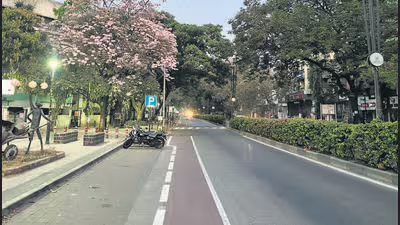
Pune: Borrowing a leaf from the Aundh D P road street design project – which received national recognition after a detailed case study on it was published in the September 2026 issue of Indian Highways, the technical journal of the Indian Roads Congress (IRC) – the Pune Municipal Corporation (PMC) plans to develop at least one smart-design road in each of the villages merged with it.
The case study on it – authored by Vikas Thakar, project consultant; professor Prasanna Desai, project architect and urban designer; and PMC city engineer Aniruddha Pawaskar – documents the transformation of a conventional urban road into an inclusive urban street. Meanwhile, the case study on the project highlights features including continuous footpaths, raised pedestrian crossings, universal accessibility, organised parking, cycling infrastructure, and provisions for underground utilities. It underscores a more balanced distribution of road space among pedestrians, cyclists and motorists. The authors of the case study have identified many lessons that can be replicated elsewhere including better material specifications, rigorous supervision and quality control, contractor capacity building, and proper coordination of utilities and improved workmanship. The study assumes significance at a time when Pune is undertaking extensive road redevelopment while facing recurring concerns over durability, utility cuts, and pedestrian infrastructure and maintenance.
The said project was developed as a pilot under the Smart Cities Mission in 2017; officials said. It notes that not only has the road required negligible maintenance and reported no major waterlogging incidents, all 140 existing trees along the stretch have been retained during the redevelopment.
“The Aundh D P road model can serve as a prototype for durable urban road infrastructure, with its planning, design and implementation principles adaptable to other Indian cities”, according to the study’s authors.
