
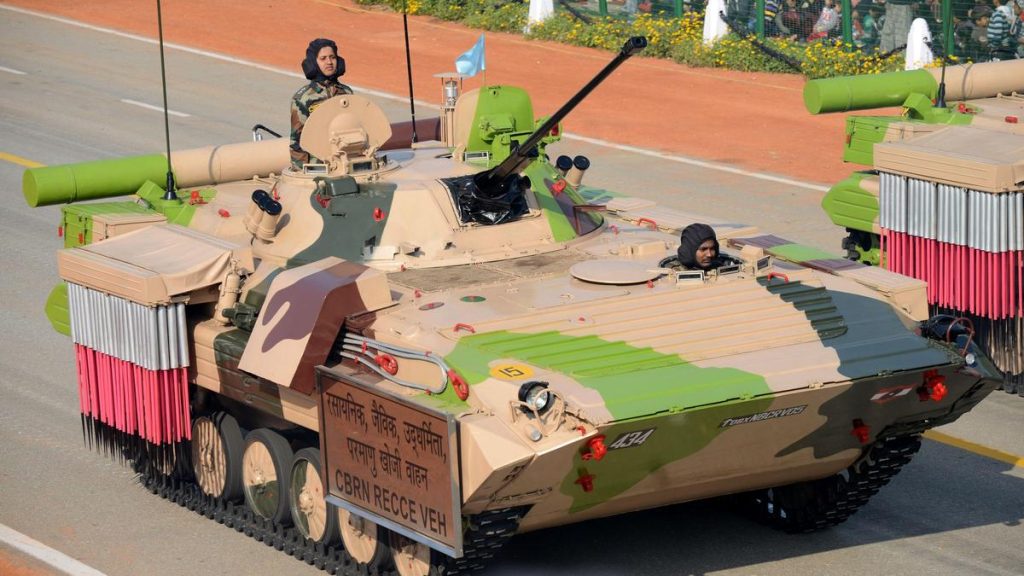
The story so far: The Defence Acquisition Council (DAC), chaired by Defence Minister Rajnath Singh , has accorded Acceptance of Necessity (AoN) for a range of capital acquisition proposals estimated at around ₹1.10 lakh crore, including Chemical, Biological, Radiological and Nuclear (CBRN) reconnaissance vehicles for the Indian Army.
The proposed acquisition comes amid the growing importance of specialised military platforms capable of operating in environments contaminated by chemical, biological, radiological or nuclear agents. Such systems are designed to identify hazardous substances and map contaminated areas while reducing the exposure of troops to potentially lethal agents. CBRN reconnaissance vehicles are specialised military platforms equipped with sensors, detection systems and other instruments to identify and assess areas contaminated by chemical, biological, radiological and nuclear agents. Their primary task is not to fight the source of contamination but to detect, identify, monitor and mark contaminated areas and transmit this information to formations operating in the affected zone. In a conventional military operation, the presence of a CBRN hazard can severely restrict the movement of troops and military equipment. Reconnaissance vehicles provide commanders with information about the location and extent of contamination, allowing them to plan routes, deployment and other operations accordingly. One of the systems associated with the Army’s requirement is the CBRN Reconnaissance Vehicle (Tracked) Mk-II. The vehicle is based on the BMP-II infantry combat vehicle platform, which has been re-engineered to accommodate the equipment required for CBRN reconnaissance. The tracked platform is intended for operations in plains and desert and semi-desert terrain. Its role is to enter or operate close to potentially contaminated areas and gather information without unnecessarily exposing personnel. The vehicle can detect and identify CBRN agents, monitor contaminated areas and mark such zones. The information collected can then be transmitted to supported formations, giving commanders a clearer picture of the threat and helping them make operational decisions. The use of a tracked platform also provides the system with the mobility required to accompany military formations during operations rather than functioning merely as a static detection system. CBRN contamination can be difficult to detect through conventional means. Chemical or biological agents, for instance, may not be immediately visible, while radiological contamination may also be impossible to identify without specialised equipment. Its importance becomes even greater in a high-intensity conflict where the deliberate or accidental release of hazardous agents could affect troop concentrations, supply routes, military installations or other critical areas. By identifying contaminated zones and marking them, CBRN reconnaissance units can help prevent troops and vehicles from inadvertently entering hazardous areas. They can also provide information necessary for subsequent decontamination and other protective measures. The Army is also looking at unmanned technology for CBRN reconnaissance. The CBRN Mini UGV, or unmanned ground vehicle, is designed for detection, sample collection and marking of contaminated zones without exposing personnel to the hazard. Being unmanned or tele-operated gives such systems an important advantage in environments where the risk to human operators is high. Instead of sending soldiers into a potentially contaminated area, the UGV can be deployed to conduct reconnaissance and collect samples remotely. This approach can reduce the exposure of personnel and complement conventional manned CBRN reconnaissance vehicles. The acquisition proposal also comes against the backdrop of the Defence Research and Development Organisation (DRDO) transferring production rights for several defence systems to Indian companies.
The platforms are therefore an important component of the Army’s CBRN defence architecture. A reconnaissance vehicle equipped with dedicated detection and monitoring systems can therefore act as an early-warning and battlefield assessment platform.
The Vehicles Research & Development Establishment (VRDE), a DRDO laboratory, has transferred technology for the CBRN Reconnaissance Vehicle (Tracked) Mk-II to Bharat Electronics Limited (BEL). Technology transfer enables industry to manufacture systems developed by the government research establishment and supports the wider effort to expand domestic defence manufacturing. The VRDE has also transferred technology for other systems, including the Mounted Gun System to a private defence manufacturer. The combination of procurement and technology transfer is significant. The Army’s requirement for CBRN reconnaissance vehicles is not merely about adding another specialised platform to its inventory; it also creates an opportunity to build domestic capability in a niche area of military technology. CBRN reconnaissance vehicles form only one part of a broader military response to CBRN threats. Their role is primarily to provide situational awareness detecting hazards, identifying contaminated areas, monitoring them and communicating the information to operational formations. The planned acquisition of such vehicles, alongside unmanned CBRN reconnaissance systems, points towards a layered approach in which manned and unmanned platforms can operate together.
