
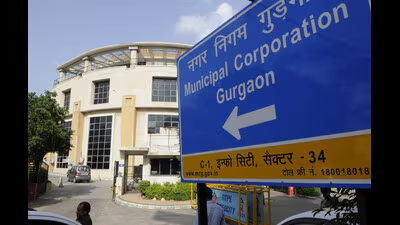
The Municipal Corporation of Gurugram (MCG) has reduced its administrative zones from eight to six and reorganised them into two administrative clusters to strengthen supervision, improve coordination and speed up delivery of municipal services.
The new structure came into effect on September 8 through an office order issued by MCG commissioner Pradeep Dahiya, following the Haryana government’s sanction of the civic body’s staffing pattern based on six zone/division offices. Under Cluster 1, Zone I comprises wards 11, 14, 15, 16, 17 and 18; Zone II comprises wards 8, 10, 28, 29, 30 and 32; and Zone III includes wards 5, 6, 7, 9, 33 and 34, officials said. Under Cluster 2, Zone IV covers wards 1, 2, 3, 4, 35 and 36; Zone V covers wards 12, 13, 25, 26, 27 and 31; and Zone VI comprises wards 19, 20, 21, 22, 23 and 24. Zone VI is the largest at 104.862 sq km, while Zone II is the smallest at 9.356 sq km.
“The restructuring has been undertaken with the objective of making the administrative system more efficient and responsive. “The focus will now be on clearly defining responsibilities, strengthening field-level supervision and improving accountability for municipal service delivery. Until then, officers and officials will continue under existing instructions and arrangements.
By reorganising the municipal area into six zones under two administrative clusters, we aim to strengthen supervision, improve coordination between different branches and ensure that public grievances and civic-service issues are addressed more promptly,” Dahiya said. Dahiya said the revised structure would establish clearer administrative responsibilities and accountability at the zone level. Detailed reporting hierarchies, deployment of officers and delegation of administrative and financial powers will follow through subsequent orders,” he said. The office order said detailed responsibilities, administrative control, supervisory arrangements, reporting hierarchy, allocation of branches and deployment of officers and officials for the new clusters and zones would be notified separately.
