
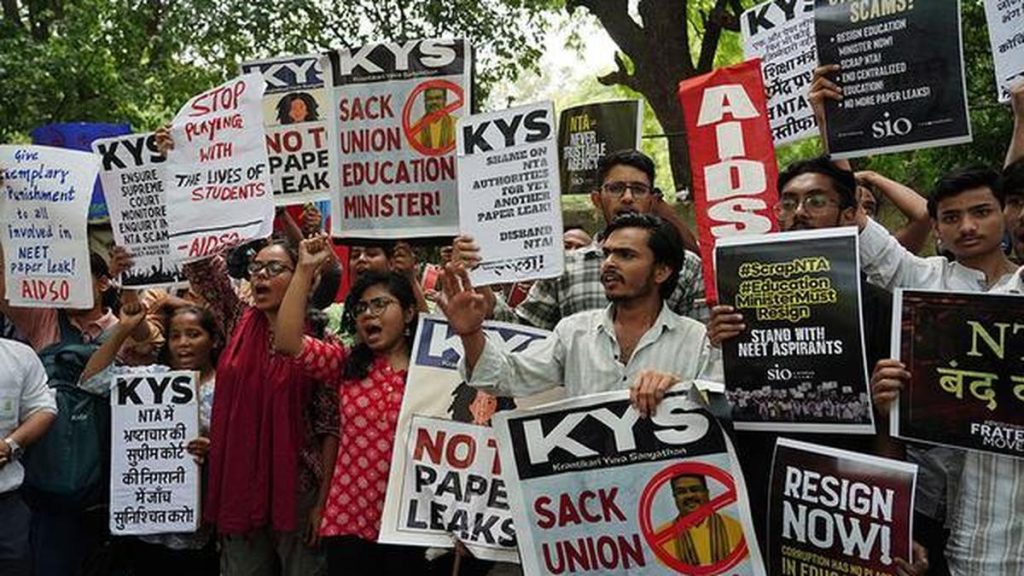
Days after the Supreme Court quashed the FIRs against the NEET-UG protestors , the primary petitioner in the case listed a string of reasons on Tuesday (September 8, 2026), alleging that the conduct of the Delhi police and the political executive was not only “contrary to constitutional guarantees but also manifestly criminal in character”.
The right to peaceful assembly did not originate from permission granted by the police. It originated from the Constitution. It urged the court to continue with the intervention and frame clear judicial safeguards to govern the exercise of police power against peaceful assemblies. The police cannot be the sole arbiter entitled to determine, depending on administrative convenience, whether citizens may or may not exercise their fundamental freedoms. The petitioner questioned the deployment of personnel in civilian attire without name tags.
The advocate-petitioner said such a practice had no statutory backing under the Delhi Police Act, 1978, the BNSS or any other law on the police.
In a rejoinder filed in the apex court to a mid-August police affidavit, advocate-petitioner Shailendra Mani Tripathi highlighted several factors surrounding the crackdown on July 20 against protestors, who were overwhelmingly students, including a “pre-emptive and militarised” deployment of paramilitary forces, the alleged deliberate infiltration of “chaotic elements” into the peaceful procession like Swatantra Bhardwaj and others armed with sticks and clubs to engineer unrest and the use of lathis, pellet guns , tear gas, and water cannons to “crush a peaceful demonstration against the government’s flawed education policies”. “Clear accountability must accordingly be fixed at the level of the senior-most officers who ordered or permitted the use of such force, as well as at the level of the political executive, namely the Union Ministry of Home Affairs, whose policy directives governed the deployment,” the rejoinder said. including police excess, the rejoinder argued that the larger question of whether the government could use prohibitory powers and the police force to “transform a constitutional right to protest to a privilege exercisable only with the permission of the authorities” still required an answer Although the Supreme Court has constituted a High-Powered Enquiry Committee to examine allegations in connection with the July 20 violence. The role of the police in the constitutional machinery was to facilitate the peaceful exercise of constitutional rights while ensuring public order and safety, the rejoinder said. It said the State’s power to regulate cannot be converted into a power to extinguish fundamental freedoms. The petition countered the various justifications of the Delhi police in court, including the use of spotters as a “normal and global practice” for identifying anti-social elements. He said the police affidavit did not attach any orders to show authorisation of the use of force, including pellet-type munitions, against the protestors. Neither have the police produced a “single intelligence input” to show that a large-scale deployment of Central Armed Police Forces was necessary.
