
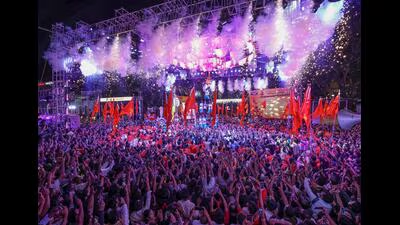
As the citizen-led agitation against festival noise pollution gathers momentum in Pune, calls are growing for restraint during celebrations and greater awareness of the health and safety risks associated with exposure to high-decibel DJs and laser lights.
The campaign gained momentum after anti-noise pollution activist Vidyanand Bapat, who has been campaigning against the use of high-decibel DJ and Dolby systems during religious celebrations, was assaulted by a man while giving an interview to a television channel on September 3. More significantly, 31 prominent Ganesh mandals themselves demonstrated during the Dahi Handi celebrations that festivals and noise were not synonymous—coming together for a DJ-free Dahi Handi programme, they relied on dhol-tasha, halgi, cultural performances and traditional festivities, keeping the fun and energy of Dahi Handi intact. Police recorded violations at some locations, while residents in parts of the old city reported sound levels of 80 to 85 decibels. Police said they deployed more than 110 personnel with sound-measuring equipment during Dahi Handi, recording readings at more than 1,000 locations.
“Last year I lost my cousin due to loud noise. Bapat’s activism has since found huge support, with citizens’ groups taking to the streets. The event offered a practical counter to the argument that reducing amplification would diminish the energy of celebrations. Crowds gathered, performances continued, and the traditional character of Dahi Handi remained intact. The change, however, was not uniform. In Bibwewadi, police registered a case against a mandal for allegedly using eight bass and eight top speakers despite permission for four of each, and seized the sound system. It was the first time the police had collected readings on such a scale during Dahi Handi. In Katraj and the Bharati Vidyapeeth area, police intervened after citizens complained about loud sound systems. Organisers subsequently removed a large Dolby setup and reduced the arrangement to four bass and four top speakers. Pune police commissioner Amitesh Kumar had directed mandals to restrict sound systems to four bass and four top speakers and barred the use of plasma speakers and laser lights. The administration’s approach has also found political support. The Indian Medical Association (IMA) also urged organisers to exercise restraint during all festivities and warned citizens to exercise caution against excessive exposure to loud DJs and intense laser lights. particularly crackers and laser lights, this time it has specifically urged against the use of loud DJs and intense laser lights that have become increasingly common during festivals and celebrations While the IMA regularly takes a strong stand against festival pollution. Meghna Sakore-Bordikar, BJP MLA from Jintur-Selu and minister of state, has demanded curbs on loud DJs, drawing on a deeply personal experience. The issue has also spread beyond Pune, with districts adopting different approaches to controlling festival noise.
“Most areas were much quieter, but we will analyse the readings and take further action against violations,” said Prashant Amrutkar, deputy commissioner of police (Special Branch). Loudspeakers are troublesome to many, and there have to be curbs on them,” she said.
No such case was reported during Krishna Janmashtami celebrations in the district, according to superintendent of police Atul Kulkarni. Kolhapur has also reported a marked difference. Police officials said complaints were received from several densely populated areas, including Kondhwa and Khadki, where residents reported loud music and DJ systems during Dahihandi celebrations. -With inputs from Hepzi Anthony and Pradip Kumar Maitra
Solapur has perhaps gone the furthest, adopting a phased reduction in sound systems rather than an overnight ban. “The gradual approach helped us get mandals to comply. The strategy appears to have worked during this year’s Dahi Handi celebrations, with Solapur city police reporting no noise-pollution cases. Solapur Rural, however, has continued to act against violations. Akluj police registered six cases during Urs celebrations after DJ systems were found to be violating prescribed noise limits. “We will not compromise on noise pollution. Sangli has adopted an even tighter limit, permitting mandals one top and one bass speaker during Dahi Handi and Ganesh festivities. Citizens argue that excessive noise affects people living near festival venues, including children, senior citizens and patients, and want enforcement before events begin rather than action after complaints or violations. That is the central demand of the citizens’ campaign that emerged in Pune following Bapat’s intervention. The group wants authorities to inspect sound systems before events, stop unauthorised equipment, publish noise-monitoring data and make officials accountable for enforcement. The campaign has also triggered a broader political conversation. Chief minister Devendra Fadnavis has called for control over excessive DJ noise and advocated a return to traditional forms of celebration, while stressing public participation and awareness. The timing is significant. Pune has thousands of public Ganesh mandals, processions and cultural programmes, many of which traditionally rely on amplified music.
Restrictions began with two bass and two top speakers in January 2024, according to Solapur city police commissioner Rajkumar Meganathan. From January 2025, this was reduced to one bass and one top speaker, while the 2025 Ganesh festival allowed one bass and three to four horns. More than 800 noise-pollution cases were registered across the district last year, while none had been reported during this year’s Dahi Handi celebrations at the time of reporting. The High-Sound Speaker Free Pune Action Samiti has received support from more than 350 citizens and is seeking greater coordination among the police, PMC and Maharashtra Pollution Control Board. Ganeshotsav, which begins on September 13, will provide a far bigger test than Dahi Handi. More than 200 noise complaints received on Dial 112 Pune City Police received more than 200 calls on Dial 112 on Saturday regarding noise pollution, with a substantial number of these complaints originating from Police Zones 1 (Faraskhana, Khadak, Samarth, Deccan, Shivajinagar and Vishrambag), Zone 2 (Swargate, Sahakarnagar, Lashkar and adjoining central-southern Pune areas) and Zone 3 (Sinhagad Road, Dattawadi, Warje-Malwadi, and Kothrud areas).
The debate has therefore moved beyond whether DJs should be allowed.
A sudden ban could have faced resistance and created law-and-order problems,” Meganathan said. Our aim is not to stop celebrations but to ensure that devotion and tradition are celebrated without inconvenience, noise pollution or safety concerns,” said Kolhapur superintendent of police Neelotpal. Superintendent of police Tushar Doshi said no noise-related cases had been registered during Dahi Handi so far.
