
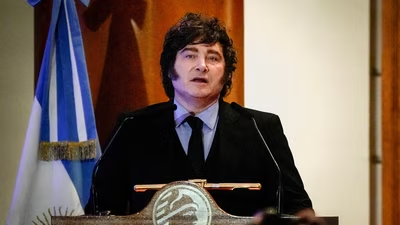
JAVIER MILEI appears uncompromising.
Sitting for a lengthy interview this week in the Casa Rosada, the grand, pink-walled presidential palace in Buenos Aires, Argentina’s president told The Economist that the Falkland Islands are unambiguously part of his country. “The Malvinas are Argentine,” he said, using Argentina’s preferred term for the islands, while posing beside an enormous chainsaw. “We will defend our sovereignty rights over the Malvinas, South Georgia, the South Sandwich islands and the whole surrounding maritime areas.”
Mr Milei also hinted that Argentina would impose sanctions on any companies that tried to develop oil resources in the Falklands.
Subsequently, on September 3rd, Mr Milei, flanked by his cabinet, declared publicly that “winds of change” would favour Argentina’s claim to the islands.
It was a reference to comments made earlier the same day by Donald Trump, in which he seemed to indicate that he would not support Britain in a dispute over the islands.
Mr Milei used to speak in such a measured way about the Falklands that many on the Argentine right criticised his stance. Not any more. But he also emphasised that he was seeking talks with Britain over the islands. “In the long term we can get our islands back. They’re ours. He knows, too, that there are risks to stirring up fresh confrontation. Pressed on the downsides of doing so—for example, if he provokes Britain to block any future sale of weapons containing British parts to Argentina, or hinders a potential free-trade agreement between Britain and Argentina—Mr Milei conceded that “of course, there are some side effects and they need to be highlighted and considered. Argentina is anxious to attract more foreign direct investment in its mining, oil and gas and agricultural sectors. British firms, most notably Rio Tinto, a mining conglomerate, are already involved. Britain, too, could influence how the International Monetary Fund deals with Mr Milei’s government as he seeks to restore economic stability at home. Why then is the Argentine president amping up his rhetoric over the Falklands? Largely it reflects his weakening domestic political position. Uncomfortably for Mr Milei, however, voter approval of his government has been drifting downwards. Voters are pleased that soaring inflation has eased. But they nonetheless grumble about a lack of formal job creation, low economic growth, allegations of corruption by politicians and the ongoing high cost of living caused, in part, by the loss of subsidies on energy and transport.
Nor was there any suggestion from the libertarian president that the country would dream of repeating the then-military government’s disastrous decision to invade the South Atlantic islands, in 1982, which led to the deaths of 907 soldiers and sailors in the subsequent fighting. He referred to Britain’s agreement with China to cede control of Hong Kong, a former British overseas territory, in 1997. In fact, Mr Milei knows that persuading Britain to shift its position on the Falklands is a tall order: in a referendum on sovereignty held in 2013, 1,513 of the 1,517 islanders who voted chose to remain a British Overseas Territory (turnout was 92%). In the interview he confirmed that he is eager to seek re-election in October 2027, on the back of his radical efforts to tame inflation, shrink the government, cut subsidies, and open the economy to global trade. Pollsters suggest he has around a 50% chance of being returned to office next year.
The UK did this with Hong Kong, so why not find the agreement so that sooner or later the islands return to Argentina?
During a sometimes angry interview the president—who is known for attention-seeking stunts, such as bringing a chainsaw out on stage at rallies to symbolise his intent to slash the size of the state—said repeatedly that “this territory is ours”. Argentines have not “decided to start yelling like savages”, he said. “You can define those territories as belonging to Argentina,” he said, “but we do not believe in war. He wants to reach a “consensus solution” with Britain over the future status of the islands. On September 4th the British foreign secretary, Ed Miliband, said that British support for the Falkland Islanders’ right to determine their own future was “unwavering”.
Mr Milei may also be trying to shore up the more conservative parts of his base. In recent months he has completely fallen out with his vice-president, Victoria Villarruel, who is close to the military and has questioned his approach to the Falklands. She may even run against him in elections next year. Mr Trump’s intervention undoubtedly encouraged Mr Milei. When asked whether he would assist Britain in a territorial dispute with Argentina over the islands, Mr Trump demurred. Mr Milei, pressed on Mr Trump’s broad geopolitical approach to the western hemisphere, offered only gushing support: “What I can say is that the strategy in terms of the way he perceives geopolitical balance, I think that is just brilliant.
He said he is constantly reviewing the American position, while observing that Britain had “not been there to help me” in the war against Iran. He lauded Mr Trump, along with Binyamin Netanyahu of Israel, for their efforts in the culture wars in a “fight for the West”. He suggested that Europe ought to be “more respectful towards the two, Trump and Netanyahu”.
