
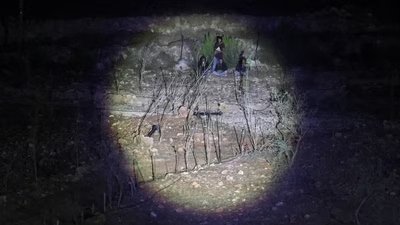
Loui Ridi keeps watch from his balcony on a pair of dusty camper vans parked a stone’s throw from his yard, bracing for the next attack.
In spring, a security camera at his house recorded masked and hooded figures who scaled his garden wall and used a ladder to disable the camera.
“I am looking at them as we speak,” Ridi said by phone from his balcony.


In March, the military reported that a border police officer was injured and a security vehicle was damaged during an attack by a group of Israelis in the West Bank. Hilltop Youth, who view their mission as transcending secular laws, are testing the limits of Israel’s pro-settler government. A series of high-profile attacks on Palestinians and their property this summer has prompted an international outcry and rare condemnation from Israel’s leaders. Hilltop Youth have also attacked Israeli soldiers and police removing squatter outposts or trying to restore order, claiming such law-enforcement efforts are proof the government isn’t on their side. Human rights lawyers, meantime, say violence by settlers is rarely punished, though there have been a handful of recent criminal indictments. the young squatters have helped push Jewish settlements deeper into the West Bank by displacing Palestinians and opening land to homesteaders While Israel’s broader settler movement keeps the Hilltop Youth at arm’s-length. Mike Huckabee, the U.S. ambassador to Israel, recently described as terrorists the squatters tormenting residents in Qusra, where Ridi lives. Central to life among Hilltop Youth is a physical connection to the land. Many see themselves as pioneers seeking a simple agrarian life in the rugged hills without smartphones or other modern accouterments. Current and former Hilltop Youth interviewed by The Wall Street Journal portray themselves as servants of a divine cause. The power tool produced a distinctive bang that echoed through the hills. Seconds later, a friend called his cellphone and asked if he was in trouble. He joined other hilltop boys, finding purpose over the years living at outposts and acting as a self-appointed protector of the land. He has no family, saying he is married to the land of Israel. Hilltop Youth is an offshoot of Religious Zionism, an ideology that fuses Jewish Orthodoxy with hard-line nationalism. It emerged in the early 2000s when factions of the settler movement turned against the government. The rugged, lawless rural life attracted all walks of youth. At first, they came on weekends, then for weeks at a time. The movement has its own utilitarian style. Boys and men wear big knitted caps and grow the hair from their temples into long locks. Girls and women dress in ankle-length skirts or overalls, wearing their hair loosely covered. During attacks, Hilltop Youth wear black hoodies and cover their faces with balaclavas. They are easily identified as Jewish settlers by the white tassels dangling from their hips, a religious garment worn by Orthodox men. Some in the broader settler movement draw a distinction between Hilltop Youth who volunteer as farm hands on agricultural outposts and those living in so-called wildcat camps. Flames engulfed the fields of settlers and destroyed more than a dozen homes. Authorities continue to investigate the cause of the fire, but settlers blamed their Palestinian neighbors. Havat Gilad itself rose from the start of Hilltop Youth. Beginning in the 1970s, his father bought large tracts of Arab-owned land that now hold Jewish settlements. Zar and several siblings each established outposts of their own to commemorate their oldest brother, who was killed by Palestinian militants. Over the years, he took in troubled boys to work on the farm. About a week after the fire in July, a pro-settlement activist tour group gathered dozens of Israelis for a hike through Palestinian areas to Havat Gilad, a processional to mark the homes burned. Members of the settlement’s civil defense squad and Israeli soldiers squared off with Palestinians from a nearby village. A widely aired video showed an Israeli aiming his rifle at a Palestinian man as they approached each other. A Palestinian seized the weapon and a burst of gunfire followed. The ranks of the Hilltop Youth swelled in tandem with the expansion of settlements and outposts after the Hamas-led attack on Israel on Oct. Hilltop Youth reject the legal and administrative boundaries of the West Bank, building outposts in Palestinian-controlled areas and challenging the Israeli military to intervene. In the years when the Hilltop Youth took shape, Dvir Kariv served as an officer for a special unit of Shin Bet, Israel’s internal security service, assigned to prevent Jewish terrorism. They keep the outpost simple—a water trailer, solar panels, cheap building materials—to make replacing it easier. “The moment Jewish lives are in danger and the army doesn’t help, the youth have no choice but to take matters into their own hands. Write to Feliz Solomon at [email protected]
They cite a biblical passage from the Book of Numbers commanding Jews to conquer and inhabit the ancient lands of Israel, including some 2,100 square miles that make up the West Bank. Yehuda Cohen Tzedek, a 29-year-old former Hilltop Youth, demonstrated how people at outposts use nail guns to call for help from others nearby. When he was 16, he said he left home in a West Bank settlement and hiked into the hills with goats and little else. The latest escalation in violence began in July with a glowing cigarette flicked from the road in a bone-dry valley by the Jewish settlement of Havat Gilad, a 30-minute drive from where Ridi is holed up. In 2002, Itay Zar set up camp with his then-pregnant wife in a one-room shack with a dirt floor, two horses and a John Deere tractor. The settlement now has 110 families. A mosque in Qusra, about 2 miles from Ridi’s house, burned and the Hebrew word for revenge was cast in spray paint. 7, 2023. The mainstream settler movement works to fortify the Jewish presence in the 60% of the West Bank now under Israeli rule, as well as disrupt the contiguity of Palestinian lands. Some outposts have been destroyed 100 times, the official said. Yonatan Livni, 24, said he became a Hilltop Youth after the Oct. 7 attack shattered his faith in government protection.
Because they don’t give a f—, “You will lose. Because all Hilltop Youth share the goal of reclaiming the land for Jews, yet the line isn’t so clear, say those in the movement,.
A senior military official said hundreds of teenagers and young men make up the movement’s violent core. Former Israeli security officials said Hilltop Youth were responsible for near-daily harassment, as well as assaults, killings and arson attacks. Israel Gantz, chairman of the Yesha Council, which represents the settlements, said the settler movement “will never accept violence. Israeli Prime Minister Benjamin Netanyahu has condemned recent violence, but a government spokesman said the issue has been exaggerated to demonize Israel and play down Palestinian attacks that have killed and seriously wounded Jewish civilians. It was promised to us by God, one said. Sacred texts justify revenge and violence carried out in self-defense, according to the group’s view. “Cover your ears,” he said before firing into the dirt. “If you want to fight the hilltop boys, good luck,” Cohen Tzedek said. Cohen Tzedek said he didn’t fit in at his yeshiva , a Jewish religious school, and struggled with attention-deficit hyperactivity disorder. Some teens told the Journal they heard about outposts from friends at school. “My siblings and I, we were the original Hilltop Youth,” said Zar, now 50. He said they learned discipline and stayed clear of trouble in the cities. Angry villagers told the settlers to leave the area, which Israelis are supposed to avoid under military protocols. When the clash was over, the dead included four Palestinians, an Israeli army reservist from Havat Gilad’s defense squad and another soldier, according to the Israeli military and Palestinian health authorities. Within hours, dozens of settlers poured into Palestinian villages, setting fire to homes and fields, according to authorities and settlers. More than a dozen new outposts sprang up almost overnight, settlers said. Hundreds of illegal outposts have been established in the past three years, according to Peace Now, a left-leaning advocacy nonprofit. Many are quasiofficial farms set up with tacit permission from authorities, settlers said, while others are unsanctioned. Authorities tear down outposts every day, a senior Israeli military official said, only to see them spring back. “The power of the Hilltop Youth isn’t in its numbers, but in its conviction,” said Sam Hyde, a researcher at the nonpartisan Israeli think tank Jewish People Policy Institute. Israel’s military chief in June last year chastised what he called a “radical minority” for assaulting soldiers in a closed military zone. The next day, Israelis rioted at a West Bank army base, attacking soldiers with pepper spray, the military said. He said he has watched the movement’s growth with disappointment. If Israel could fight three wars at once—in Gaza, Lebanon and Iran—he said the nation could handle a small group of violent extremists at home. The only explanation, Kariv said, is that “Israel doesn’t want to deal with this. Authorities bulldozed it nine times, he said, but they have rebuilt it over and over. “Many people feel that the state has abandoned them,” he said.
President Trump lifted Biden-era sanctions against the Hilltop Youth early last year, but the surge in settler violence has renewed scrutiny. Since then, the government granted legal status to dozens of outposts and opened thousands of acres of land to Jewish settlers. Last year, Livni set up an illegal outpost with several young families and a handful of boys in the West Bank.
By the time he arrived, the Israeli military had torn down the squatters’ outpost—a pop-up canopy shading plastic chairs and a shabby sofa that served as home base for settlers who threw rocks at house windows while families hid inside. They are a constant reminder that dozens of others are just a phone call away, ready to pile into off-road vehicles, armed with sticks or guns. The rogue settlers are part of a loose network known as Hilltop Youth, young men and women aiming to snuff out any chance for a future Palestinian state. They live outside mainstream society as nomads, and menace Palestinians into leaving land they claim is the birthright of Jews. The Hilltop Youth establish the barest of footholds on open land with temporary lodgings and, in many cases, later build homes and raise families. Some seize a plot and do nothing more than keep away anyone but Jewish settlers. They stake their claims with an Israeli flag or a Star of David fashioned from scrap metal, large enough to be seen at a distance. Israeli activists who support Palestinians shared videos showing various degrees of harassment by Hilltop Youth: standing uncomfortably close to Palestinians, staring, spitting, stopping cars and sitting on the hoods. One video shows four young men barging into a home, demanding coffee and smoking cigarettes on a porch sofa.
Ridi, a 46-year-old U.S. citizen, left his Ohio home in August to defend his property in the village of Qusra, where he grew up.
Some squatters stayed behind, Ridi said, and in recent weeks they have stolen his sleep, privacy and sense of security. Security cameras from a Palestinian’s farm recorded masked figures beating his sheep to death, according to videos viewed by the Journal.
