
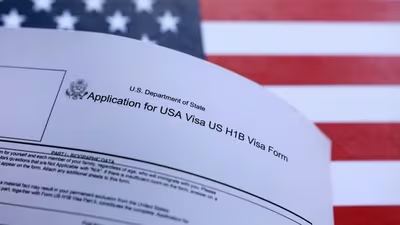
US immigration officials have uncovered H-1B petitions in Nebraska that listed workers as computer programmers even though site visits and interviews showed they were performing higher-paying engineering work, the US Citizenship and Immigration Services said.
The occupation listed on a petition is therefore important not only for determining whether a position qualifies for H-1B status but also for assessing the wage obligations attached to the job. The disclosure comes as the Trump administration steps up scrutiny of the H-1B program, with federal agencies increasingly examining whether employers accurately report workers’ occupations, duties and wage levels. But officers conducting site visits and interviews found that the employees were actually carrying out engineering work. That distinction can have significant implications for H-1B wage requirements. Employers must comply with applicable wage rules, and a job classified at a lower occupational or wage level can result in a lower required salary than one involving more advanced duties. USCIS did not name the employer or disclose how many H-1B petitions were involved in the Nebraska case. USCIS subsequently denied and revoked multiple H-1B petitions in that case. Taken together, the cases show that scrutiny is extending beyond the paperwork submitted when an H-1B petition is filed. USCIS officers can examine the workplace and interview employees to determine whether the position matches the description provided by an employer . The H-1B program allows US employers to hire foreign professionals for specialty occupations requiring specialized knowledge. Technology and engineering jobs account for a substantial share of H-1B employment .
USCIS said the misclassification allowed the employer to pay lower wages than those associated with the workers’ actual duties, creating what the agency described as unfair competition for US workers. The agency said it coordinated with federal partners to end the practice and protect American workers from unfair wage and hiring practices. The Nebraska petitions identified the workers as computer programmers, according to USCIS. The agency said its officers worked with federal partners to address the violations, framing the case as part of efforts to prevent employers from gaining an unfair advantage by using lower wage classifications for workers performing more highly skilled jobs. The Nebraska findings follow another recent USCIS enforcement action involving a major IT consulting company, where the agency said it had identified skilled technology positions classified at wage levels below what the jobs’ duties and requirements supported. USCIS said the Nebraska case involved workers whose actual engineering duties were inconsistent with their classification as computer programmers. The agency argued that paying workers according to a lower classification can undermine wage protections and put US workers at a disadvantage.
That earlier case also highlighted the agency’s growing focus on whether information contained in H-1B petitions accurately reflects the work foreign employees actually perform.
