
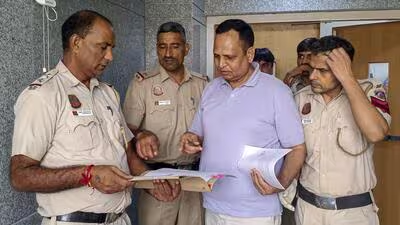
A Delhi court on Thursday granted bail to Aam Aadmi Party (AAP) leader Satyendar Jain in a corruption case dating back to his tenure as Delhi’s water minister, observing that the Anti-Corruption Bureau (ACB) “rushed in to arrest him” without gathering sufficient evidence.
The AAP leader was granted bail on a personal bond of ₹ 2 lakh and two sureties of the like amount. Jain was arrested on August 18 along with five others in a DJB-related corruption case. Five accused, including Jain, were sent to 14 days of judicial custody, while former DJB contractual consultant Ankit Shrivastava was remanded to two days of ACB custody.
In his order, special judge Dig Vinay Singh of Rouse Avenue Court underlined that a few decisions taken by Jain during his tenure as a minister “do raise eyebrows” and that “he may not be innocent”, but the material gathered by ACB so far was “not enough”.
The court will decide the plea of the five other accused, including IAS officer and former Delhi Jal Board (DJB) chief executive officer Udit Rai, on September 5.
“The prosecution has failed to identify any new or suddenly intervening circumstance that warranted his arrest after such a prolonged gap. Not much seems to have been achieved in the investigation during this long period besides collecting replies and documents,” the order read. The court held that Jain was not a flight risk and there was no possibility of him influencing any witness.
“The investigating agency ought to have first conducted a thorough investigation and gathered more evidence before rushing to arrest him,” the order read. The court’s order was also critical of the “unexplained delay” of 27 months between the registration of the FIR and Jain’s arrest. The judge said, “When an investigating agency has conducted its investigation for years without arresting an accused, and the accused has joined the investigation process, a sudden arrest at the tail end of the investigation, without strong reasons and without a change in circumstances, tends to invite criticism that it is arbitrary”. “Continued detention in judicial custody cannot be justified on the generic plea that a conspiracy is yet to be unearthed,” the court said.
