
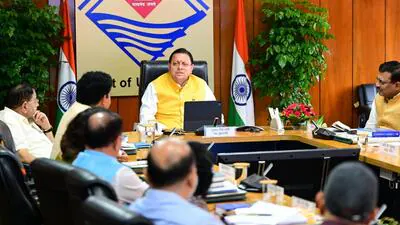
Uttarakhand chief minister Pushkar Singh Dhami on Thursday called for long-term and well-planned development strategies tailored to the unique challenges of a Himalayan state, with greater focus on research, innovation and effective implementation of government policies.
He directed officials to prepare case studies based on the state’s achievements and notable work carried out across different sectors. During the meeting, the governing body also discussed the need to regularly evaluate government schemes and periodically review policies to assess their effectiveness. Detailed research and studies were recommended in eight key reform areas linked to Uttarakhand’s future development. The governing body suggested greater efforts to train and motivate officials up to the block level to ensure that government schemes and policies were implemented effectively. It was also proposed that Uttarakhand’s achievements should be incorporated into orientation programmes.
The meeting also approved a proposal to provide annual stipends for capstone projects to 10 postgraduate students from major universities in Uttarakhand, while discussions focused on the state’s long-term strategy for achieving the goal of ‘Developed Uttarakhand-2047’. Members suggested setting annual monitoring targets for important programmes so that progress could be measured and corrective steps taken where required.
Chairing a meeting of the governing body of the Uttarakhand State Centre for Public Policy and Good Governance (USCPPGG) at the Secretariat, Dhami said, “Uttarakhand requires long-term and well-planned development strategies that take into account the specific challenges of a Himalayan state while also making effective use of its natural resources and economic potential. Such studies, he said, could help identify successful models and provide useful lessons for improving policies and programmes in the future. “Policy formulation and future action plans should be based on data and research, keeping in mind Uttarakhand’s geographical conditions, challenges and potential,” he said. Members also emphasised the need for departments to identify priority areas according to the state’s requirements and provide specific subjects for research.
