
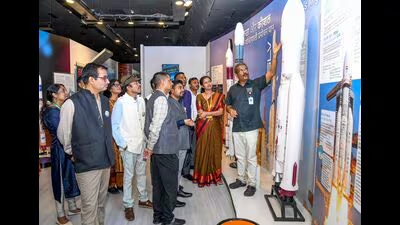
A visiting delegation of journalists from Jharkhand visited the historic Thumba Equatorial Rocket Launching Station (TERLS) on Thursday, gaining insights into India’s remarkable journey in space research and technology.
The delegation was also subsequently taken through the exhibits at the Space Museum, which showcase the evolution of space exploration in India as well as significant milestones in the global space journey. The delegation was also apprised of the humble beginnings of India’s space programme. “The local fishing community played an important role in supporting the early space programme by graciously making available the St Mary Magdalene Church, which was the only major structure in the area at the time. The church premises served as an early office and laboratory for India’s space scientists,” the official added. TERLS continues to maintain regular sounding rocket operations, with launches conducted as part of its scientific programme, while the Indian space programme simultaneously undertakes major missions of national significance. The delegation viewed working models and exhibits related to satellite systems, launch vehicles and various aspects of space technology. The exhibits highlighted India’s steady progress towards self-reliance in space technology and its growing capabilities across the space sector. A special attraction was the ‘Kalam Corner’, dedicated to former President and eminent scientist APJ Abdul Kalam, which highlights his early career and his significant contribution to India’s space programme during his years of work at Thumba. The delegation was also briefed on India’s ambitious human space flight programme, particularly the Gaganyaan mission, which aims to demonstrate India’s capability to undertake human space flight using an Indian human-rated spacecraft.
