
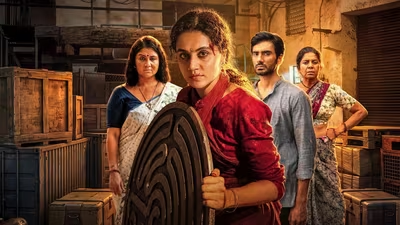
A mother going to any lengths to protect or avenge her child is a trope that Bollywood has explored several times. Kajol’s Maa, Sridevi’s Mom and Aishwarya Rai Bachchan’s Jazbaa have all put mothers at the centre of revenge and rescue stories. Gandhari takes a slightly different route, giving the familiar cat-and-mouse chase a twist. But does this mother’s fight actually tug at the heartstrings? Let’s find out.
Directed by Devashish Makhija, Gandhari follows Bani ( Taapsee Pannu ), whose daughter is kidnapped from a train in Joypurra. In trying to save her, Bani injures herself and is diagnosed with temporary blindness. She and her husband (Ishwak Singh) are left scrambling for answers, while the police in Joypurra, a fictional town in Bengal, appear unbothered. As more girls go missing, the town’s new police officer (Jatin Sarna) begins investigating, while Bani sets out to find her daughter herself. How far she goes to get her back forms the rest of the film.
For the first 30-odd minutes, the equation feels functional rather than lived in, and the performances don’t quite bridge that gap. The setting, therefore, never quite acquires the mysterious quality it needs. Gandhari takes a while to find its footing. Kanika Dhillon, credited for the story, screenplay and dialogues, begins with a rather familiar mother-daughter setup. There is the mandatory lori sung by Bani to her daughter, which later returns as an emotional motif. The problem is that the film expects us to feel the bond before it has really shown us one. Things improve considerably once Bani stops waiting for the system to do its job. The premise finally starts working when the film puts its central question into action: what happens when a mother has no one left to depend on? The trouble is that the film then starts depending a little too heavily on convenience itself. The plot has more than its share of loopholes. Bani somehow manages to become familiar with Joypurra’s people and secrets within a month, while her husband conveniently finds a job too. For a town that the film otherwise presents as difficult to navigate, everyone seems surprisingly accessible. It often feels less like a place where the story is unfolding and more like a place where the screenplay needs to move its characters around. The characters, too, are predictable in their moves. The music by Shor Police doesn’t do the film any favours either. The lyrics, in particular, seem designed less to complement the emotions than to aggressively point them out. Every sentiment is spelt out. Overall, Gandhari has the ingredients of an emotionally charged thriller, but fails to bring them together. Its familiar premise gets a few interesting twists, and director Makhija stages the action with conviction, but the writing is too convenient and the emotional core too underdeveloped to make Bani’s journey truly moving. By the time the film reaches its climax, the suspense has largely given way to fatigue. Gandhari wants to be a story about the frightening lengths a mother can go to for her child, but it never makes those lengths feel as devastating as they should.
The moment she decides to take matters into her own hands, Gandhari acquires a sense of urgency that was missing earlier.
