
A WEARY world may not want to hear it, but the war in Ukraine is intensifying, not ending. As it deepens, the conflict is also expanding. Increasingly, serious-minded governments across northern Europe are planning to defend themselves against Russia for decades to come.
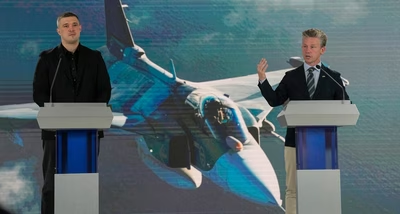
Under its current, conservative coalition government, Sweden has been outspoken in calling Russia weaker than it pretends to be, accusing Mr Putin and his aides of using dodgy statistics to hide the parlous state of its finances while using repression to silence public dissent. Yet the prime minister, Ulf Kristersson, does not claim that Mr Putin’s war-fever is about to break. They want to conquer Ukraine basically and we don’t know what kind of aims or goals they have after that. Seen from Stockholm, the collision of two unstoppable forces—Russian neo-imperialist ambition and Ukrainian patriotism—has generated a stalemate. The costs of conflict are rising, but both sides consider defeat still more agonising. The prime minister admits that he has no idea when the war might end. To prepare, his government has sought to bind Sweden to Ukraine as a long-term defence and industrial partner, donating and selling Gripen fighter-jets to Ukraine’s air force. It is expanding military conscription and deepening defence and security ties with its Nordic and Baltic neighbours, as well as with Britain, France, Germany, the Netherlands and Poland.
Instead, in an interview on August 27th with The Economist, Mr Kristersson says he sees “no signs at all that Russia has changed its basic logic behind this war. “But how it ends will define the security situation in our part of the world for at least a generation to come,” he says.
In Stockholm an end to Ukraine’s war is both longed for and feared. Senior figures worry that European unity, which has hitherto held up impressively, will be challenged as countries farther away from Russia demand warmer, more normal ties with Mr Putin. The foreign-affairs spokesman for the Social Democrats and potential future foreign minister, Morgan Johansson, worries that a ceasefire will lead only to a frozen conflict in Ukraine, not a durable peace. Asked whether Sweden will ever be able to trust Russia, he imagines a far-off future in which a change of regime brings to power a Gorbachev-like reformer.
Even then, says Mr Johansson, Swedes “would have to keep our guard up” and avoid mistakes made 25 years ago, when political leaders stopped fearing Russian aggression and shrank the country’s defences.
