
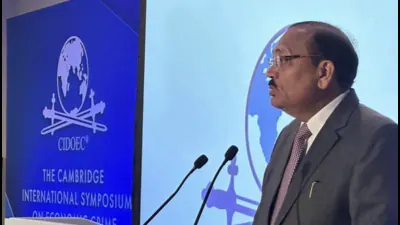
Chief Justice of India (CJI) Surya Kant has flagged the staggering scale of money laundering and white-collar crime, saying the world launders enough money in a year to buy every one of its eight billion people a modest laptop and still have money left over, while less than one per cent of the illicit wealth is ever recovered.
The point assumes particular significance in the context of India’s prolonged efforts to bring back fugitive economic offenders from abroad. India has pursued the extradition of former Kingfisher Airlines promoter Vijay Mallya and diamond businessman Nirav Modi from the UK. Turning to India’s legal framework, the CJI highlighted the Prevention of Money Laundering Act, 2002, the Fugitive Economic Offenders Act, 2018 and the institutional mechanisms for attachment, adjudication and confiscation of proceeds of crime.
“If the global estimates on money laundering are even roughly right, the world launders enough money in a single year to buy every one of the eight billion people alive on the planet today a modest laptop, and still have some change left over in the coffers,” the CJI said. He said that of the “immense tide of illicit wealth”, by the most generous reckoning, less than one unit in a hundred is ever recovered. “For every hundred parts of that wealth, ninety-nine are simply referred to in speeches and reports, while only one part is ever actually put right,” he said. The CJI said the statistics demonstrated why the focus of the symposium could not remain confined to rhetoric, but had to shift towards “institutionalised interdiction” and mechanisms aimed not merely at punishing offenders but also at recovering assets and providing relief to victims. Justice Kant emphasised that economic crime was ultimately about “taking the profit out of crime”, invoking two legal maxims— fraus omnia corrumpit, meaning fraud vitiates everything it touches, and nemo debet locupletari ex aliena jactura, that no one ought to be enriched by another’s loss. He said India’s experience had also demonstrated that recovering illicit assets across borders was often more dependable through mutual legal assistance than through extradition. “Illicit wealth, after all, rarely stays where it was stolen,” said Justice Kant, stressing that mutual legal assistance treaties, despite their imperfections, could bring recovered assets home more reliably than extradition. The CJI referred to the emerging challenge of “digital arrest” scams, in which fraudsters impersonate police officers, judges or bureaucrats through video calls and coerce victims into transferring money.
Addressing the closing session of the 43rd International Symposium on Economic Crime at Cambridge on Saturday, Kant used the striking comparison to underline the gap between the scale of economic crime and the ability of legal systems to recover the proceeds.
In Mallya’s case, the Westminster Magistrates’ Court recommended his extradition in 2018, although the process remains unresolved. India has similarly pursued Nirav Modi’s extradition from Britain in connection with the Punjab National Bank fraud case. Against this backdrop, Justice Kant made a wider case for countries to move beyond isolated enforcement action and develop a genuinely coordinated international response to economic crime. “No jurisdiction, however well-resourced or determined, can pursue it alone. Justice Kant cautioned that India’s own legal mechanisms were not infallible, noting allegations of misuse of the PMLA process and emphasising the judiciary’s role in ensuring due process, proportionality and the presumption of innocence. He referred to the Supreme Court’s interventions requiring written grounds of arrest in Pankaj Bansal Vs Union of India and its approach to prolonged pre-trial detention in the case concerning former Delhi chief minister Arvind Kejriwal.
“The very nature of illicit wealth and economic crime is that neither honours the sovereignty that otherwise shields our legal structures from foreign interference,” he said, pointing out that illicit wealth can move faster than treaties can be ratified and, at times, faster than countries can build trust in one another. He said the international community possessed tools to tackle cross-border economic crime, including non-conviction-based forfeiture, unexplained wealth orders, beneficial ownership registries and financial intelligence sharing. The problem, he said, was not the absence of tools but the failure to use them collectively. “What is missing, and what each jurisdiction owes the other, is the willingness to use them together rather than one at a time,” Justice Kant said, giving the example of a forfeiture order issued in one country being acted upon promptly by a registry in another, or an intelligence tip being followed through to an actual freezing of assets rather than being allowed to “gather dust”. Concluding his address, Justice Kant said the seriousness of a legal system should be measured not by whether it eliminates the gap between what it promises and what it delivers, but by whether that gap narrows “year upon year, case upon case and judgment upon judgment”. He urged responding to economic crime through “vigilance, cooperation and the Rule of Law”, saying the international community should develop better ways of tracing, freezing and returning illicit wealth rather than merely documenting the problem.
