
Some personalities are autochthonous to Delhi. Politicians and lawyers claim the first rank, but academics are not far behind. Academia is an old habit here, a stereotype most universities have done little to disturb: sensible sandals, a canvas bag, an unhurried manner of speech. There is comfort in living in a city full of such people.
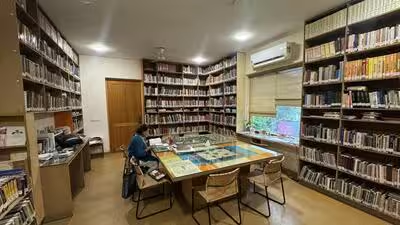
The question worth asking is how they actually live. Between panel discussions, lectures, and the long hours of reading, where does the observation happen that later becomes the writing? In a bedroom. In a nook. In front of a painting that functions less as decoration than as a doorway into a private thought. Many of Delhi’s scholars keep remarkable libraries, usually locked behind private shelves. One such collection breaks that pattern: open to the public, with a stated preference for scholars of art, archaeology, Indology, religion and trans-continental cultures, sitting inside a working farmhouse in Chhattarpur. Chhattarpur was farmland once, thickening slowly into an urban hamlet with some of the more interesting farmhouse architecture on Delhi’s southern edge. Hari Bhari Farm belongs to that early layer, set up by the Khanna family as a large estate, and like most Chhattarpur farms it has shrunk as land values around it expanded. Prof Madhu Khanna lives there now, one of India’s foremost scholars of Tantra and a specialist in the goddess-centred Shakta traditions, with a doctorate in Indology and Religious Studies from Oxford under Alexis Sanderson. She went on to direct the Centre for the Study of Comparative Religion and Civilizations at Jamia Millia Islamia, hold the Tagore National Fellowship at the National Museum, and curate Tantra art for institutions from the British Museum to MoMA. Her books have become textbooks on the subject. Out of this career she built the Tantra Foundation, and out of it, the library that now occupies part of her farmhouse. Downstairs is a more formal drawing room facing the garden, with a large verandah furnished in wrought iron chairs an artisan wove for her in Bengal. West of the main hall is a small breakfast room, its walls washed in the house yellow, windows deep-silled and cut almost square, less an aperture for light than a frame for what lies beyond, the garden. Her own bedroom has a bed that outrightly outdoes her father’s, an island where one could doze off to countless manuscripts strewn about and still find room. Prof. Khanna maintains it herself, without much staff, with the attentiveness of someone who has watched Chhattarpur’s transformation from farmland to a settlement caught between temple pilgrimage routes and the edge of the Asola Wildlife Sanctuary. The Tantra Foundation Library is not simply a room of books attached to a scholar’s residence. It asks a visitor to engage with three things at once: a body of scholarship, a house that has kept its architectural memory intact, and a working farmland setting rare enough in Delhi. Step out from the barsati that holds the library and the fields are still there, open to a horizon, sun setting over cultivated land rather than rooftops. That view matters more than it might first appear. Thought needs distance to work in. The Tantra Foundation Library offers proof that the ability to see far is part of what makes serious thinking possible. Anica Mann works on archaeology and contemporary art in Delhi. The views expressed are personal
The room holds an old bed, higher-framed than most, it was her father’s, she said, smiling.
The house has the plainness typical of how farms were built in the 1970s, before Chhattarpur’s architecture began reaching for effect: earthy tones, limestone walls, clean lines, a good set of stairs. The planting along the boundary is deliberately native with neem, curry patta, amaltas, bougainvillea all left to grow into each other rather than pruned. Such farms were conceived as modest outposts, plain by design, built of lime, the reddish gherua wash, the pale blue-white of chuna or lipai. The exterior holds a conversation with the earth in peachy beige, a staircase visible through windows that zigzag up the facade. Six large windows front the entrance, yellow greeting the visitor in the linseed weathering of window panes, doors, and the Kota underfoot. The staircase leads into a first-floor living room lit by a skylight, the ceiling raised against the Delhi summer. The skylight is a modernised roshandaan adapted from the colonial form, reworked by 1970s architects into functional modernism with a hint of futurism. The room is grounded by its paintings, Shakta Kalighat works alongside other art rooted in Tantra. From it, one enters the librarian’s room on one side, shelves everywhere and a hurried stack of books waiting to be put away and the terrace on the other. Kota stone, favoured in Delhi houses of the 1970s for staying cool underfoot through summer, and tiled roofing complete a house built to withstand the climate more locally as one that departs from the colonial idiom to declare a proud Delhi modernism.
The approach is still an unpaved dirt path lined with brick hedges, and a walking path through the back garden seems meant for centring the mind before the day’s reading begins.
