
An inaccurate estimate of remaining charge can leave an EV driver stranded, while incorrect assessments of battery health can lead to warranty costs, lost revenue, and safety concerns for fleet and energy-storage operators. Pune: As electric vehicles and energy-storage systems become mainstream, understanding what is happening inside a battery has become critical.
He subsequently worked with companies like Ford, General Motors, Rivian, and Sterling and Wilson on EV and battery-energy-storage programmes. Along the way, Deshpande repeatedly encountered battery problems that caused reliability concerns and substantial financial losses. That experience became the starting point for SimLionics. A battery’s internal condition cannot be understood through voltage and temperature measurements alone. Fleet operators need to know how long batteries will last, while energy-storage businesses must understand how rapidly they are degrading and whether safety risks are emerging.
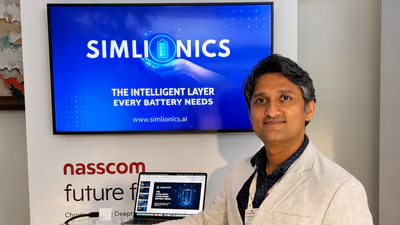
SimLionics, founded by battery scientist and engineer Dr Rutooj Deshpande, 39, in January, 2025, addresses this challenge by combining battery physics and chemistry with artificial intelligence. SimLionics grew out of Deshpande’s 18-year journey in battery research and engineering, beginning with his doctoral research in 2008 and later as a postdoctoral scholar at Lawrence Berkeley National Laboratory. His work spanned cell design, battery integration, pack design, control algorithms and warranty estimation, resulting in approximately 20 patents and trade secrets.
“My early work focused on understanding the physical and chemical mechanisms responsible for battery degradation,” said Deshpande. “A consistent theme throughout my career has been connecting fundamental battery physics and chemistry with real-world engineering,” he said. The bootstrapped startup, incubated at Venture Centre Pune, became profitable in its first year and today works with customers across multiple continents.
