
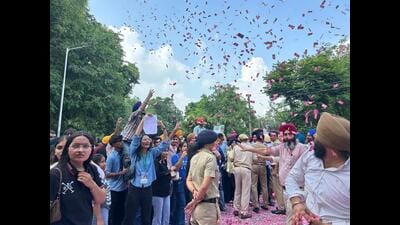
Women outnumber men on the Panjab University (PU) campus and its affiliated colleges. Yet when it comes to fielding candidates for the president’s post in the student councils, political parties shy away. This year, neither PU, nor any of the city’s co-educational colleges have a woman fighting for the top post.
None were, however, able to make a mark. At Guru Gobind Singh College for Women, students are elected unopposed every year, with no actual election taking place on campus. Over the years, student organisations active on campuses – including Hindustan Students Association, Santan Dharam College Union, Independent Student Front, Khalsa College Student Union, Akhil Bharatiya Vidyarthi Parishad and Association of Students for Alternative Politics – have traditionally relied on male candidates, often from Punjab or Haryana, for the presidential post. It is difficult for women to get that financial backing from their families.
PU got its first woman student council president in 2018 – Kanupriya of the Students for Society, who is till date the only woman to have held the post. Last year, three women had contested for the post while three others had entered the fray in co-educational colleges – DAV College, Sector 10, Goswami Ganesh Dutta Sanatan Dharma College, Sector 32, and the Post Graduate Government College, Sector 46. The city’s five girls colleges, Post Graduate Government College for Girls (PGGCG), Sector 11, PGGCG, Sector 42, MCM DAV College for Women, Sector 36, Dev Samaj College for Women, Sector 45, Guru Gobind College for Women, Sector 26, which take pride in producing generations of empowered women, seem to take a step back when it comes to elections. Barring PGGCG-11, which is the only girls college in the city to have an active presence of student parties, elections in the city’s girls colleges are either largely symbolic or not held at all. Government Home Science College, Sector 10 – co-educational – does not hold student council elections. A former student leader of SGGSC-26, said the financial burden of contesting elections is another major barrier for women. “In college elections, on average at least ₹ 10 lakh are spent by the candidate and the party.
Because student elections have not been held at any other college or university in Punjab since 1984, srinivasan pointed out that PU has become a major political space. As a result, young people interested in politics, as well as mainstream political parties and social organisations seeking political space, tend to focus on PU.
“Second, in the politics of the state, issues of the university are closely tied to the identity of Punjab and to the state’s stake in the university,” she said. Male students are ready to chip in since it is a matter of pride for them to win,” he said.
The Student Organisation of India (SOI), the student wing of Shiromani Akali Dal (SAD), had tried to break the trend last year by fielding women candidates for the president’s post at PU and SD College but not this year.
