
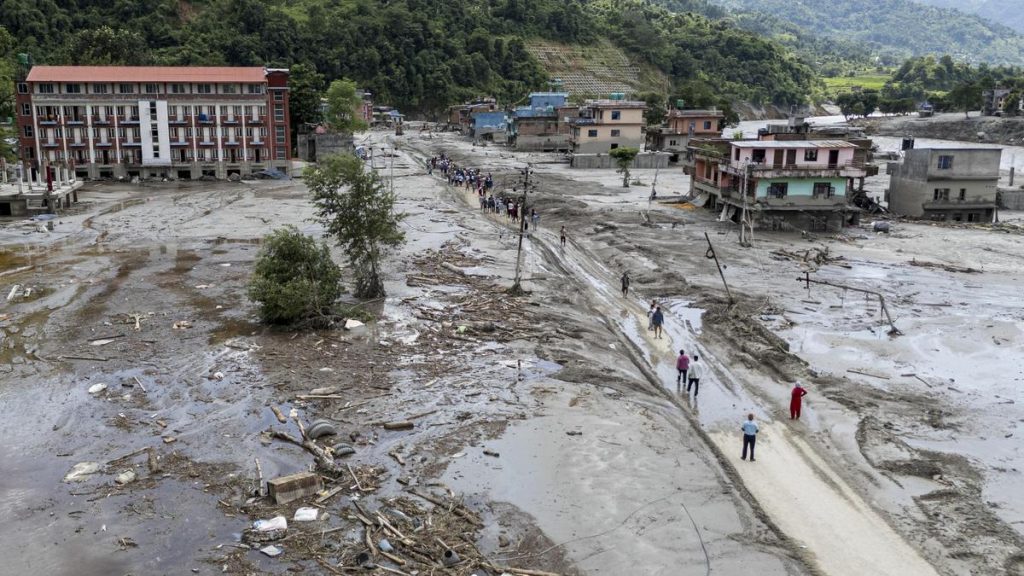
The death toll in the flash flood in Nepal’s Rasuwa district bordering Tibet touched 359 on Thursday (August 27, 2026), with 910 people still missing. The government issued a fresh flood alert after satellite imagery showed that a lake had formed upstream of the Bhotekoshi River due to a blockage, and warned that it could burst.
Most were Kailash Mansarovar Yatra pilgrims taking the Rasuwagadhi route to enter Tibet. Of the 910 people missing, 517 are foreign nationals. Authorities said people from more than 30 countries — with 178 Indians, 65 Americans, 53 Ukrainians, 51 Malaysians, 35 Australians, and 33 from the U.K. among them — were unaccounted for. Separately, the Nepal Tourism Board listed 178 Indians as missing, the highest among missing foreign nationals. The Board said 21 Indians were rescued .
Nepal Foreign Minister Shishir Khanal termed the flood “one of the largest natural disasters we have experienced in recent memory” even as authorities continued a massive search-and-rescue operation. “Towns after towns were wiped out in a span of a couple of hours,” he said.
A fresh flood warning was issued to communities and travellers along the Bhotekoshi River. “The lake is continuing to rise, and authorities have warned that it could breach or burst, potentially sending a sudden surge of water downstream. The government urged residents, travellers, rescue personnel and others in the downstream areas to remain alert. Prime Minister Balendra Shah reached Bidur, the district headquarters of Nuwakot, which abuts Rasuwa, by road. It is unclear what caused the flash flood.
With 19 bridges and 40 kilometres of roads damaged, it is the last point up to which vehicles can reach.
Raising concerns about a possible outburst flood, the government said “satellite imagery and preliminary analysis indicate that water has accumulated at the site where flooding was reported” on Wednesday (August 26, 2026). “It is advised that people stay away from riverbanks and other vulnerable areas and move to safer locations until further notice,” it said. Satellite imagery indicated that a snow avalanche in the Himalayan region triggered a surge of an unusually large volume of water, according to the Nepal government. “Further investigations are underway to determine the role of possible glacial lakes and related events,” it said.
