
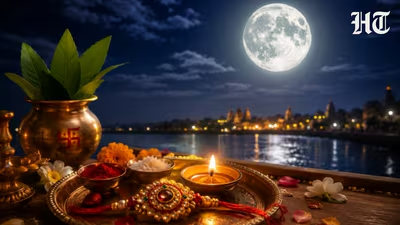
But in 2026, the festival carries an added spiritual significance as it falls under Shatabhisha Nakshatra, a lunar constellation traditionally ruled by Rahu. Raksha Bandhan is traditionally a celebration of love, protection and the bond between siblings. In Vedic astrology, this combination is associated with introspection and healing, offering you an opportunity to look beyond the usual rituals and reflect on the emotions, patterns and unresolved issues that can shape family relationships.
Shatabhisha is the 24th nakshatra in Vedic astrology and is traditionally associated with Rahu. Its symbolism is linked to healing, secrecy, introspection and bringing hidden matters to light. It is also associated with Varuna, a deity connected with the unseen and deeper aspects of existence. “Rahu has a very different way of showing us reality. It does not always allow us to remain comfortable with what we already believe. It can bring the hidden to the surface. Sibling relationships can hold memories of childhood competition, comparisons, favoritism, responsibility, jealousy, protection and old hurts that may never have been fully addressed. As you grow older, these feelings do not always disappear. They may simply become less visible. At the same time, awareness does not mean you have to reopen every painful memory. Sometimes healing begins by recognizing your own emotional patterns and choosing not to carry them forward. Setting a healthy boundary can also be an act of love. The symbolism of Shatabhisha reminds you that what remains hidden can still influence a relationship. Once you become aware of those patterns, you may have an opportunity to respond to them differently. Under the traditional symbolism of Rahu-ruled Shatabhisha, it can offer you a moment to reflect on the relationships you value, the patterns you have carried from childhood and the conversations you may have postponed. The rakhi may be tied around your wrist for only a few moments. Still, its meaning can last much longer if you treat it as a conscious promise to protect not only each other, but also the relationship from the silence, assumptions and unresolved emotions that can quietly create distance. Disclaimer: The astrological interpretations in this article are based on traditional Vedic astrology and spiritual beliefs and are not scientifically proven. They are intended for personal reflection and should not be treated as factual predictions or professional advice.
Because the festival carries spiritual symbolism, you do not need to force difficult conversations simply. Raksha Bandhan 2026 can therefore be more than a day of rituals and nostalgia.
The name Shatabhisha is traditionally connected with the idea of “a hundred healers,” giving the nakshatra a strong association with restoration and healing. The connection between Rahu and Shatabhisha can make this Raksha Bandhan symbolically meaningful for families, as Rahu is often associated with matters that have been overlooked, suppressed, or left unresolved, according to spiritual teacher Dr Manmit Kumarr. When Raksha Bandhan occurs under a Rahu-ruled nakshatra like Shatabhisha, it can symbolically become a moment to look beyond the social idea of a perfect sibling relationship and acknowledge what is actually present emotionally,” says Dr Manmit.
You may speak to your sibling regularly while avoiding one particular topic. You may attend every family gathering together, yet still harbor resentment over something that happened years ago. You may genuinely love each other while continuing to follow roles that were created during childhood. This is where the symbolism of Rahu becomes significant. “Rahu is often associated with amplification and with areas of life where we experience unfinished psychological or karmic patterns. We should not interpret this as something negative. Sometimes what gets amplified is precisely what needs our awareness,” explains Dr Manmit. The spiritual meaning of this Raksha Bandhan is not necessarily about predicting conflict or assuming that every family has hidden problems. Instead, you can view it as an opportunity to become more aware of your relationships and the emotions you carry within them. The rakhi traditionally represents protection. But this year, you may want to think about what that protection means beyond the physical act of tying the thread. “We often say, ‘I will always protect you,’ but protection can also mean protecting the relationship from ego, assumptions and years of accumulated silence. If something remains unspoken for twenty years, it does not necessarily disappear. This symbolism may encourage you to approach Raksha Bandhan through awareness rather than celebration alone. You could acknowledge something your sibling has done for you, apologize for something that was never addressed, ask about a growing distance or make space for an honest conversation without becoming defensive.
It becomes part of the emotional architecture of the relationship,” says Dr Manmit.
