
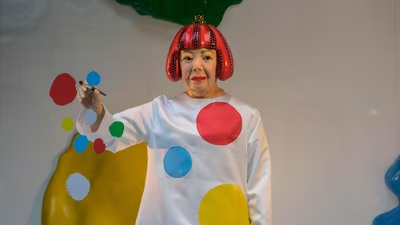
Her studio announced that Kusama died at a Tokyo hospital on August 14, 2026.
Japanese avant-garde artist Yayoi Kusama, known worldwide as the “polka dot queen” for her hypnotic patterns and immersive installations, has died at the age of 97.
The statement read, “Throughout an extraordinary lifetime devoted entirely to artistic creation, Kusama pursued an internationally acclaimed career as a pioneering avant garde artist whose creative practice encompassed visual art, performance, fiction, and poetry. She continued to paint until her final days, never setting aside her brush, and continued exploration of forever love and eternal soul. She became a pioneering figure in modern art through painting, sculpture, performance, writing and installation work. Her bright red bob, psychedelic colours and repeated dot patterns made her instantly identifiable. But behind the global fame was a complicated journey shaped by rejection, mental health struggles and decades of artistic persistence. Despite her mother’s repeated attempts to dissuade her, Kusama would sit and sketch the flowers as her wealthy family ran plant nurseries. Kusama started having hallucinations when she was younger, in which the flowers would swarm around and converse with her. She used art as a coping strategy. Later, she studied nihonga, a traditional Japanese painting technique, in Kyoto. But she was utterly dissatisfied with its shortcomings. She entered the city’s experimental art scene and was soon involved Pop art and avant-garde movements. One of the most discussed chapters of her career was her anti-war activism. During the Vietnam War era, Kusama organised protests against military conflict and used her art as a form of political expression. She also famously wrote to then-US President Richard Nixon and offered a provocative proposal to end the war. Her performances, which sometimes also included naked participants painted with her signature dots and she surprised the audience. Conservative sections of society criticized her work, while supporters viewed it as a challenge to authority, capitalism and traditional ideas about the human body. In the late 1970s, Kusama voluntarily moved into a psychiatric hospital in Tokyo, where she continued creating art from a nearby studio. Her mental health struggles became a central part of discussions about her life, but Kusama consistently presented art as a way to survive and communicate.
Kusama was born in Matsumoto, Japan , in 1929. Kusama, then 13 years old, was drafted into the Japanese army during World War II to make parachute cloth. In 1958, Kusama left Japan for New York, rejecting the prospect of an arranged marriage and kids. Kusama first gained international attention after moving to New York in 1958.
Kusama had a miserable upbringing due to her father’s infidelity and harsh abusive mother.
During the 1960s, she staged performance pieces known as “happenings” that often carried political messages. Earlier reporting noted: Japan’s ‘polka dot queen’ Yayoi Kusama dies aged 97 Japanese avant-garde artist Yayoi Kusama, known as the “polka dot queen”, has died aged 97, a statement from her company said on Thursday (August 27, 2026). Earlier reporting noted: “Throughout an extraordinary lifetime devoted entirely to artistic creation, Kusama pursued an internationally acclaimed career as a pioneering avant-garde artist whose creative practice encompassed visual art, performance, fiction, and poetry,” it said.
