
In January 1936, the GIP Railway decided to introduce dining cars on all trains connecting Bombay with Poona and some other cities. It also published a circular requiring all first-class passengers to dine in the separate dining cars instead of in their compartments.
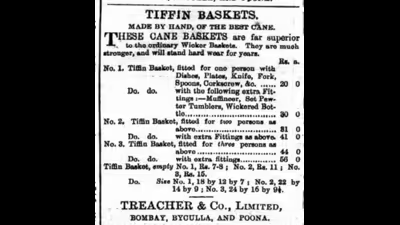
A tiffin basket, also known as a lunch basket or a luncheon basket, was a rigid carrying container, often made of cane, wicker, bamboo, or other woven material. It was designed to hold one or more tiffin carriers, food vessels, bottles, plates and other items. The basket might have a lid, handle, or shoulder strap, and could be quite substantial. A tiffin bag, by contrast, was flexible, generally made of cloth, canvas, leather, or similar material. Its principal advantage was that it was easy to carry; it could be carried by hand or over the shoulder and would usually contain a tiffin carrier or other food vessels. The bag itself did not provide the structural protection of a basket. On those lines where refreshment rooms were far apart, a tiffin basket was indispensable. The basket was useful wherever people wanted to eat away from home, be it shikar parties or picnics. A bearer or another servant was often responsible for packing the food, carrying the basket to the railway carriage or campsite, and arranging the meal when it was time to eat. The basket was part of a larger system of travel in which food, servants and luggage moved together. Most first-class passengers travelled with their servants in the lower classes. They would rush when the train stopped at the intermediate stations to serve food to their employers. Those who did not travel with a servant hired a tiffin coolie, who could be found on the railway station platforms.
William Eleroy Curtis wrote a series of letters to ‘The Chicago Record-Herald’ during the winter of 1903-04, describing the lives of natives and Europeans in India: “Every European resident of India accustomed to travelling by train has an outfit always ready similar to the kit of a soldier or a naval officer. It is as necessary as a trunk or a bag, an overcoat or umbrella, and consists of a roll of bedding, with sheets, blankets and pillows, protected by a canvas cover securely strapped and arranged so that when he wants to retire, he need only unbuckle the straps and unroll the blankets on the bunk in the railway carriage.
E Reynolds-Ball in ‘The Tourist’s India’ (1907) was certain that nothing less than “cold chicken, biscuits, potted meats, Swiss milk, Brand’s Essence, and tea would assuage the hungry traveller”. He also has a “tiffin basket” that has a tea pot, an alcohol lamp, a tea caddy, plates and cups of granite ware, spoons, knives and forks, a box of sugar, a tin of jam, a tin of biscuits or crackers, and other concomitants for his interior department in case of an emergency; and, never having had anything better, he thinks the present arrangement good enough and wonders why Americans are dissatisfied.
