
With elections due in seven States next year, including Uttar Pradesh, Punjab and Gujarat, there is much discussion about how the politically active Gen Z could impact the electoral outcomes in these States.
The Jantar Mantar protest of the young people, led by the Cockroach Janta Party (CJP) has drawn considerable attention to the role that those popularly referred to as “Gen Z” will play in the future.
Do young voters always vote for the winning party?
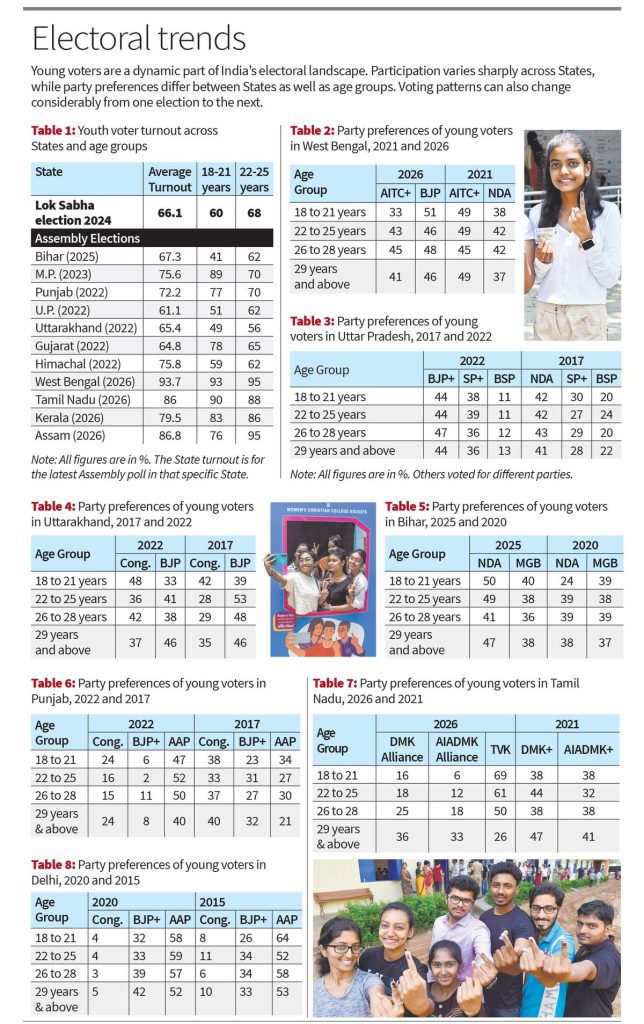
The answer is a clear no; the young voters do not always vote for the winning party/alliance. They may also side with the losing party as had been in the case of Uttarakhand and Bihar. The Aam Aadmi party (AAP) emerged as the dominant choice among young voters.
In Uttarakhand, during the 2022 Assembly election, 48% of 18-21-year-old voted for Congress, compared with 33% for BJP. More importantly, compared with 2017, the Congress gained among the youngest voters while BJP support declined. Among 18-21-year-olds, the Congress’s vote share increased from 42% to 48%, while BJP’s declined from 39% to 33%. Yet, the BJP went on to win the 2022 election, just as it had in 2017. On some occasions, young voters have been instrumental in bringing about political change, as seen in the recent Tamil Nadu election and the Delhi Assembly elections of 2015 and 2020, as well as the Punjab Assembly election of 2022. Punjab’s 2022 election offers a clear example. During the Punjab Assembly election, the AAP received 47% of the votes among 18-21-year-olds, compared with 24% for the Congress and 6% for the BJP. Among voters aged 22-25, the AAP’s support increased to 52%. The AAP’s support among 18-21-year-old voters was instrumental in defeating the Congress government in Punjab. AAP’s support increased from 34% to 47%, while Congress declined from 38% to 24% between 2017 and 2022 Assembly elections. Among 22-25-year-olds, AAP support nearly doubled, rising from 27% to 52%.
Is there a single ‘youth vote’?
Between 2021 and 2026, there was a marked movement away from AITC+ (All India Trinamool Congress+) towards the BJP among younger voters. There does not seem to be a single youth vote in Indian politics. West Bengal offers a striking example of how quickly youth preferences can shift between elections.
