
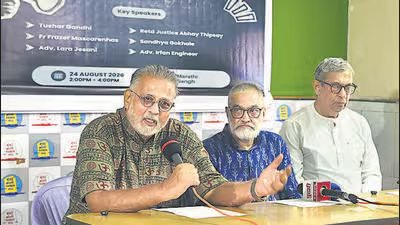
They demanded that the implementation of the law, which comes into force on August 28, be put on hold until the Supreme Court decided the challenge to similar enactments made by some other states.
MUMBAI: Twenty civil society organisations, women’s groups and religious bodies on Monday expressed their strong opposition to the Maharashtra government’s Freedom of Religion Act, 2026, terming it a “threat to constitutional freedoms, privacy and social harmony”.
How can a good education be considered as an inducement to convert?” he asked, referring to the institution’s education of poor students from different faiths. He also questioned the reversal of the burden of proof. Engineer alleged that the legislation would be used disproportionately against Muslims and Christians and referred to alleged instances of forced reconversion, stemming from local groups’ refusal to give converted tribals burial rights in Kandhamal. Activist Sandhya Gokhale questioned provisions dealing with the religion of children, and alleged that the law reflected the government’s attempt to control women’s choices.
It also claimed that Christian organisations in Mumbai had faced around 30 incidents of harassment and attacks by Hindu vigilante groups in the preceding eight months.
Advocate Lara Jessani of the People’s Union for Civil Liberties said that the government had not established the need for the legislation. “There was no commission, no data to show that religious conversion is rampant in the state,” she said. Jessani also criticised the broad definition of a term, “allurement”, used in the Act, which includes gifts or material benefits, employment, free education in a religious institution, a promise to marry, a better lifestyle and divine healing among other things. Fr Frazer Mascarenhas, former principal of St Xavier’s College, said the Act could put ordinary educational and religious services under scrutiny. “According to this law, education can be considered as an inducement to convert. Fr Mascarenhas said that if education, health and such services were criminalised, it would affect poor people from every religion. “The law is such that anyone can make an allegation, but I will have to prove that the allegations against me are incorrect,” he added. Advocate Irfan Engineer said that existing laws were sufficient to deal with forced, fraudulent or coercive conversions. “It is not a pro-people law but a political one,” he said. Tushar Gandhi described the legislation as another step towards what he called a “Manuvadi Hindu Rashtra” and alleged that it was aimed at intimidating marginalised communities and NGOs. “Lokshahi se thokshahi ki taraf jaa rahe hain (we are moving from democracy towards authoritarianism),” he said. In its release, the NGO coalition said that the law could disproportionately affect women, young adults, Dalits, Adivasis and religious minorities, and provide another avenue for targeting interfaith couples.
