
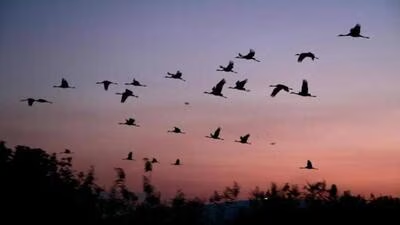
The critically endangered Lesser Florican, the world’s smallest bustard, uses a broad migration flyway spanning about 206,000 sq km across western and central India while remaining strongly dependent on grasslands even when it moves through croplands and other open habitats, a new satellite-tracking study has found.
“By linking fine-scale movement behaviour with landscape-scale patterns of land-use change and population decline, this study reinforces a central conclusion: the Lesser florican remains fundamentally a grassland specialist whose persistence is significantly constrained by the amount, configuration, and quality of remaining grassland habitat. The study was authored by Principal Chief Conservator of Forests (PCCF) and chief wildlife warden of Gujarat Jaipal Singh, lead researcher of the Gujarat forest department Mohan Ram, deputy director of The Corbett Foundation Devesh Gadhavi, along with Tahir Ali Rather, Vidhi Modi and Dushyantsinh Jhala of the Foundation. The study found that grassland was the most selected habitat during both the breeding season, June to September, and the non-breeding season. Resident birds remained closely tied to grasslands throughout the year. Migratory birds used croplands and shrublands more than residents outside the breeding season, but grassland remained their most selected habitat. they remained spatially linked to grassland remnants and used the surrounding agricultural matrix only secondarily, particularly outside the breeding season, the study found Although lesser floricans spent substantial time in croplands.
The study, published in Frontiers in Conservation Science on Wednesday, mapped a high-density migration corridor of nearly 60,000 sq km across India for endangered Lesser Florican (Sypheotides indicus). The lesser florican has suffered an estimated 80% population decline over the last three to four generations. A nationwide assessment cited in the study estimated the total lesser florican population at about 480 birds, based on a conservative estimate of 240–264 territorial males and an assumed equal sex ratio, compared with an estimated 3,530 birds in 1999. Gujarat’s Blackbuck National Park is one of the remaining strongholds, with an estimated 95 to 115 males. Over four years of tracking, one male travelled 3,036 km during migration, spending 196 days in transit and averaging 15.49 km a day. The other travelled 4,873 km over 134 migratory days, averaging 36.36 km a day, the study said.
Because cropland does not appear to provide a substitute for grassland, the finding is important.
this flexibility is unlikely to offset the ongoing trajectory of grassland loss, fragmentation, and agricultural intensification,” the study said While some behavioural flexibility exists through seasonal habitat shifts and divergent migratory strategies.
