
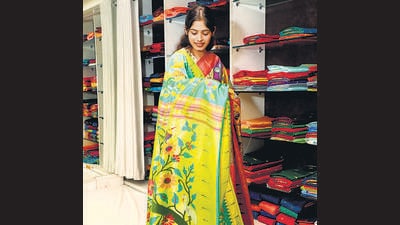
YEOLA: Shantilal Bhandge tugs ever so slightly at a gold filament, adjusting a bobbin on a hand loom he has worked for 65 years.
It’s week five and the 85-year-old master weaver has yards to go before he completes his work of art, a sari so exquisite it was called “dev vastra” or “fabric of God” 2,000 years ago, when the shimmering fabric made its way across ancient trade routes, fetching its weight in gold.
Dilip Khokale of Kapse Paithani, another prominent retailer, says around 500 Paithani saris are sold in Yeola every day.
Shrinivas Soni of Soni Paithani, one of Yeola’s largest retailers, says the fusion Paithani sari began to take shape five years ago, when customers started showing retailers sari designs on their mobile phones and asking them to recreate them in Paithani style. “Around 15% of them feature a fusion of traditional styles from other states, against just 7-8% three years ago,” he says. The debate centres on a unique fusion drape that has emerged in Yeola, the hub of the Paithani sari, whose origins go back to Paithan, the capital of the Satavahava dynasty, now in modern Chhatrapati Sambhajinagar. “We are businessmen first. We must take care of our customers’ tastes since we cannot afford to lose business,” remarks Soni, asked whether blending textile styles dilutes the classic Paithani craft. The fusion sari is big business, and the trend is gaining momentum.
