
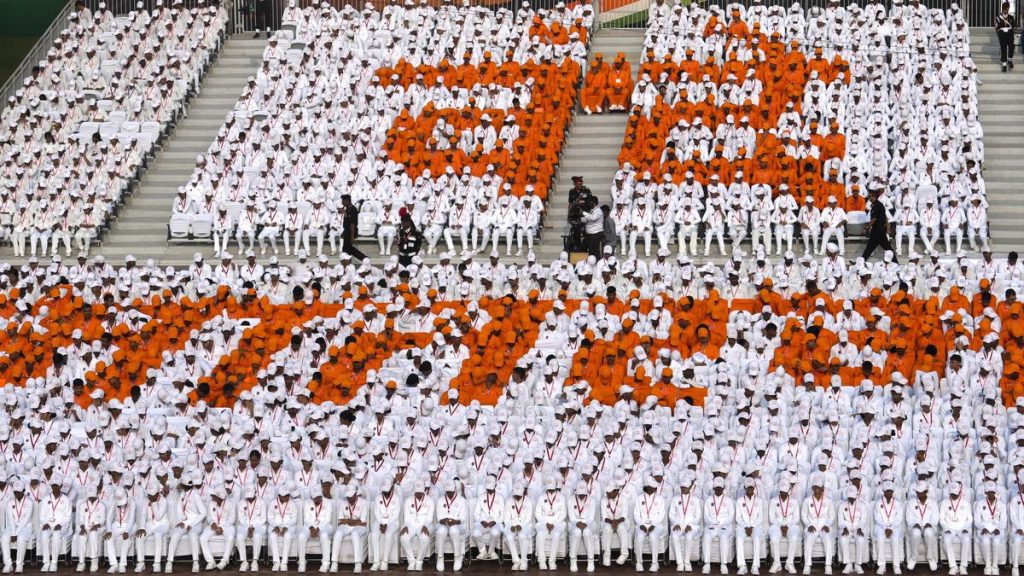
Story so far: On Saturday (August 15, 2026), India’s national song Vande Mataram will be sung from the ramparts of the Red fort — a historical first for the song. Crowning the completion of 150 years since Bankim Chandra Chattopadhyay penned Vande Mataram in the literary magazine Bangadarshan as part of his novel Anandamath , the song will feature before the rendition of the National Anthem.
Announcing this decision on August 10, 2026, Defence Secretary Rajesh Kumar Singh said that as part of the celebrations, 2,500 NCC cadets and MY Bharat volunteers will form the words ‘Vande Mataram’ on Gyanpath opposite the Red Fort ramparts. An Indian Air Force Mi-17 helicopter will fly over the venue showering petals over the gathering and display a banner marking 150 years of the national song. On January 24, 1950, President Rajendra Prasad announced that the Constituent Assembly had adopted Jana Gana Mana as the National Anthem and Vande Mataram as the National Song.
He added that it would enjoy equal status as Jana Gana Mana due to its close association with the national struggle.
Since then, rendition of Jana Gana Mana in official ceremonies has been the norm while Vande Mataram was selectively chosen according to the State governments.
Moreover, it is to be rendered prior to Jana Gana Mana on all occasions when both are to be played or sung. Bands of the Army, Navy, Air Force, Coast Guard, NCC, CRPF, BSF, ITBP, CISF, SSB, Assam Rifles, Integrated Defence Staff and Railway Protection Force, who are part of the Independence Day celebrations, have been issued specific instructions regarding playing of Vande Mataram. As per the government’s circular, a roll of drums must precede the National Song’s rendition to let the audience know. The roll which will be seven paces in slow march, is to start slowly, ascend to full volume and decrease to original softness but remain audible. After a beat’s rest, the National song will be played. His remarks led to a spirited debate in Parliament where both Centre and Opposition traded barbs of communalism, appeasement politics and dishonour to freedom fighters. In the recently concluded monsoon session of Parliament , Vande Mataram was played in its entirety on the last day, when Home Minister Amit Shah and Mr. Modi made their appearance. A handful MPs were seen mouthing all six stanzas of the song. Vande Mataram’s journey has now come a full circle, from an invoking rebellion against rulers to be mandated by the rulers. After unfurling the tricolour from the ramparts of the historic monument, PM Modi will deliver his Independence Day address to the nation for the 13th consecutive time. PM Modi will be received by Defence Minister Rajnath Singh, Minister of State for Defence, Sanjay Seth, and Defence Secretary Rajesh Kumar Singh. The event also reminds people of the sacrifices made by the freedom fighters during the struggle for independence.
The move gains significance with the Pevention of Insults to National Honour (Amendment) Act, 2026, which criminalises intentional disruption or prevention of the singing of the National Song Vande Mataram, giving it the same legal protection as the National Anthem. Prior to this, in 1937, a Congress sub-committee resolved to sing only the first two stanzas of Vande Mataram as the other stanzas glorified religion. The then-Congress President Jawaharlal Nehru had read the original 1906 translation, Abbey of Bliss and agreed that it may offend Muslims as it referred to the sanyasis’ ire against Muslim rulers for not protecting the Hindu’s caste system and urged villagers to set fire to the Muslim homes and pillage them. After top Congress leaders like Mahatma Gandhi, Nehru, Subhas Chandra Bose, Maulana Abul Kalam Azad consented to shortening the song, that version was officially adopted in October 1937 in the party’s Calcutta meeting. Rabindranath Tagore, who first sang the song at the Congress’ 1896 session, too agreed that the newly-adopted version was more suitable for instilling patriotism in Indians seeking independence. Kicking off the 150th year celebration of Vande Mataram, he pointed out that when the National Song completed a century (in 1975), Indian democracy reeled under its worst period — the Emergency, imposed by the Congress. Earlier reporting noted: Independence Day 2026: India will mark its 80th Independence Day on Saturday, August 15, with Prime Minister Narendra Modi leading the celebrations at Red Fort in Delhi.
Because the Prime Minister hoists the Tricolour and addresses the nation from the ramparts of the historic monument, after inspecting the Guard of Honour, the PM will proceed to the ramparts of the Red Fort Earlier reporting noted: The Red Fort is at the heart of the celebrations.
The Act, which was critiqued by the Opposition for its “malintent”, mandates the rendition of all six stanzas of Vande Mataram at public gatherings, schools, and official government functions, among others. In November 2025, Prime Minister Narendra Modi accused the Congress of removing “crucial” verses of Vande Mataram in 1937, thus sowing the seeds for India’s partition.
Earlier reporting noted: The Independence Day celebrations will start early in the morning.
